House of Leaves
MARK Z. DANIELEWSKI, 2000 — A RECOMMENDATION
A Preliminary Analysis of Spatial Disruption in Domestic Architecture
You begin with a simple assertion: A house is a defined space. It has walls, floors, ceilings. It has measurements. You can walk its perimeter, calculate its volume. It is a known quantity. This is the foundational assumption upon which we build our lives, the solid ground beneath our feet.
Now, consider a document. Not the house itself, but a film about the house, The Navidson Record. A film meticulously documented by a Pulitzer Prize-winning photojournalist, Will Navidson, upon moving his family into a new home on Ash Tree Lane. A document of a happy family seeking refuge and a new beginning.
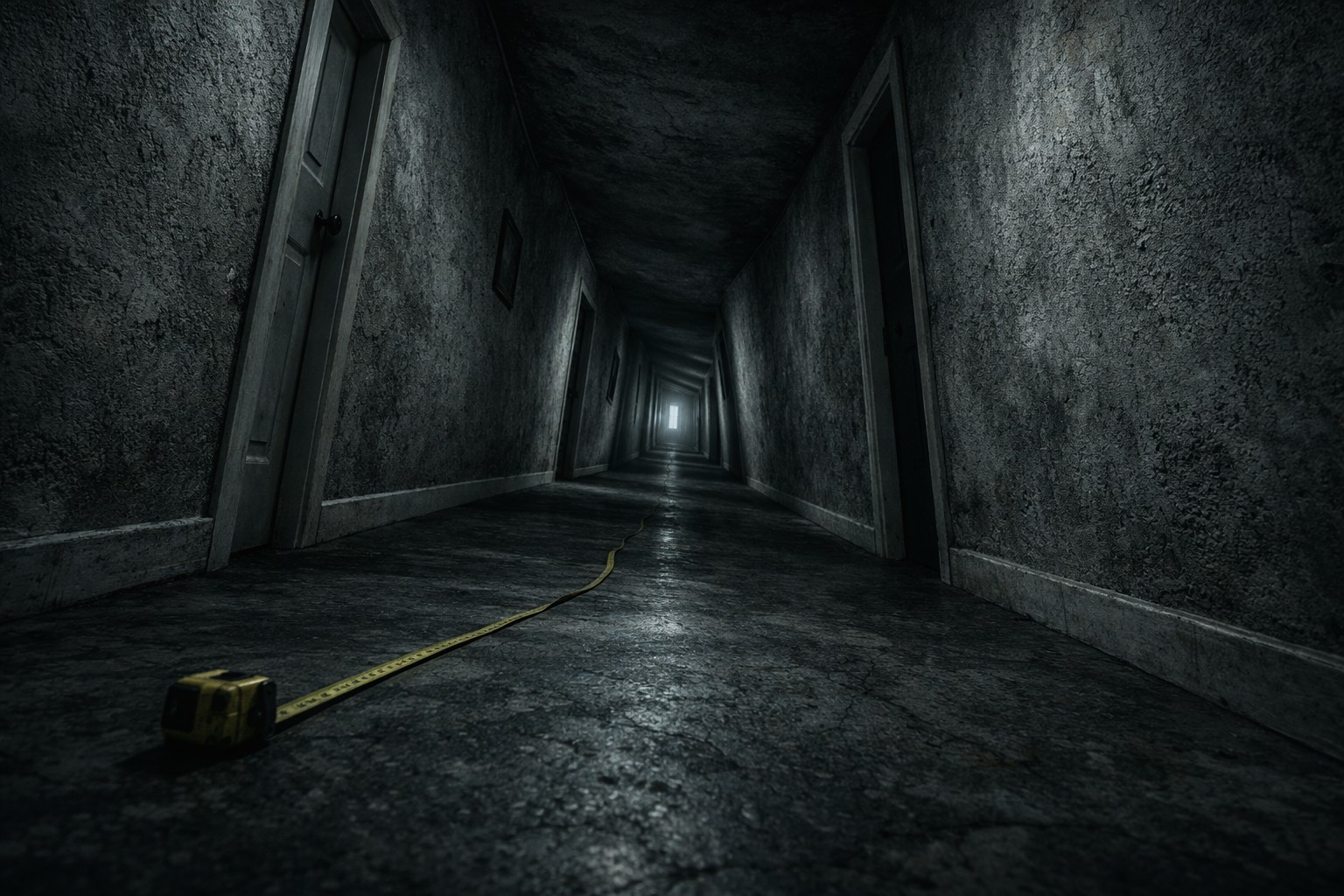
The initial anomaly is small. Almost negligible. A measurement that doesn't quite add up. An interior dimension that is fractionally, impossibly, larger than its exterior counterpart. A matter of inches. It can be dismissed. A trick of the light. A faulty tape measure. An error in calculation.
But then, a doorway appears.
Where there was once a solid wall in a child's bedroom, there is now a threshold. It opens onto a corridor. A hallway that should not exist. It is cold to the touch. It is unnaturally dark. And it leads… elsewhere. This is the central thesis of the text you are about to encounter: an exploration not of a presence, but of an absence that has become path, a void that has gained dimension. The house is no longer a static container; it has become an active variable.¹
The academic treatise you hold purports to be an analysis of this film. It is written by an old, blind man named Zampanò. His prose is dense, exhaustive, cross-referencing philosophers, architectural theorists, physicists, and filmmakers. He dissects every frame, every shadow, every spoken word of The Navidson Record. He treats the impossible hallway with scholarly rigor, a phenomenon to be cataloged and understood. He footnotes everything.
But the text you are truly reading is not Zampanò’s.
You are reading the footnotes of the man who found Zampanò’s manuscript after his death. A young man named Johnny Truant. And Johnny… Johnny is not well. His footnotes begin as simple clarifications, editorial notes. But they soon begin to unravel. They bleed into the main text, they contradict it, they consume entire pages. They are a parallel narrative of his own life falling apart as he tries to assemble Zampanò's. He speaks of paranoia, of a creeping cold he can't shake, of a constant feeling of being watched. He starts measuring the hallways in his own apartment building. He hears an echo of a growl in quiet rooms.²
What is the true subject of this book? Is it the story of the Navidson family, who decide to explore the impossible darkness that has nested within their home? Is it Zampanò’s obsessive, academic deconstruction of a film that may or may not even exist? Or is it Johnny Truant’s descent into madness, a madness seemingly contracted from the very pages you are now holding?
The book demands that you turn it upside down. It forces you to read text in mirrors. It fractures into appendices, letters from a terrified mother, poems, and collages. The words themselves will form corridors on the page, will shrink into tiny, claustrophobic squares, or will trail off into a lonely void.
This is not a book you read. It is a place you enter. It does not tell you a story of a haunted house. It is an artifact that may, in fact, do the haunting itself.
Do not seek a simple answer. Do not expect to leave the way you came in.
Just open the door.
¹ And this is where it all starts, doesn't it? The first crack in the foundation of everything. I found the manuscript in a mess of papers. Scratched out, rewritten, coffee-stained. Zampanò was dead. The guy who told me about the apartment just said, "Take what you want." I took the trunk. I shouldn't have taken the trunk. It feels cold in my apartment now. All the time.
² I swear I heard it last night. Not a growl, not really. More like... the sound space makes when it's being torn. I know that makes no sense. None of this does. I bought a new tape measure today. A long one. I just need to be sure. The hallway outside my door… it feels longer today. I know it isn't. But it feels it. My fingers are so cold I can barely type this. Why am I even typing this? It's just a story. It's just words. Right?