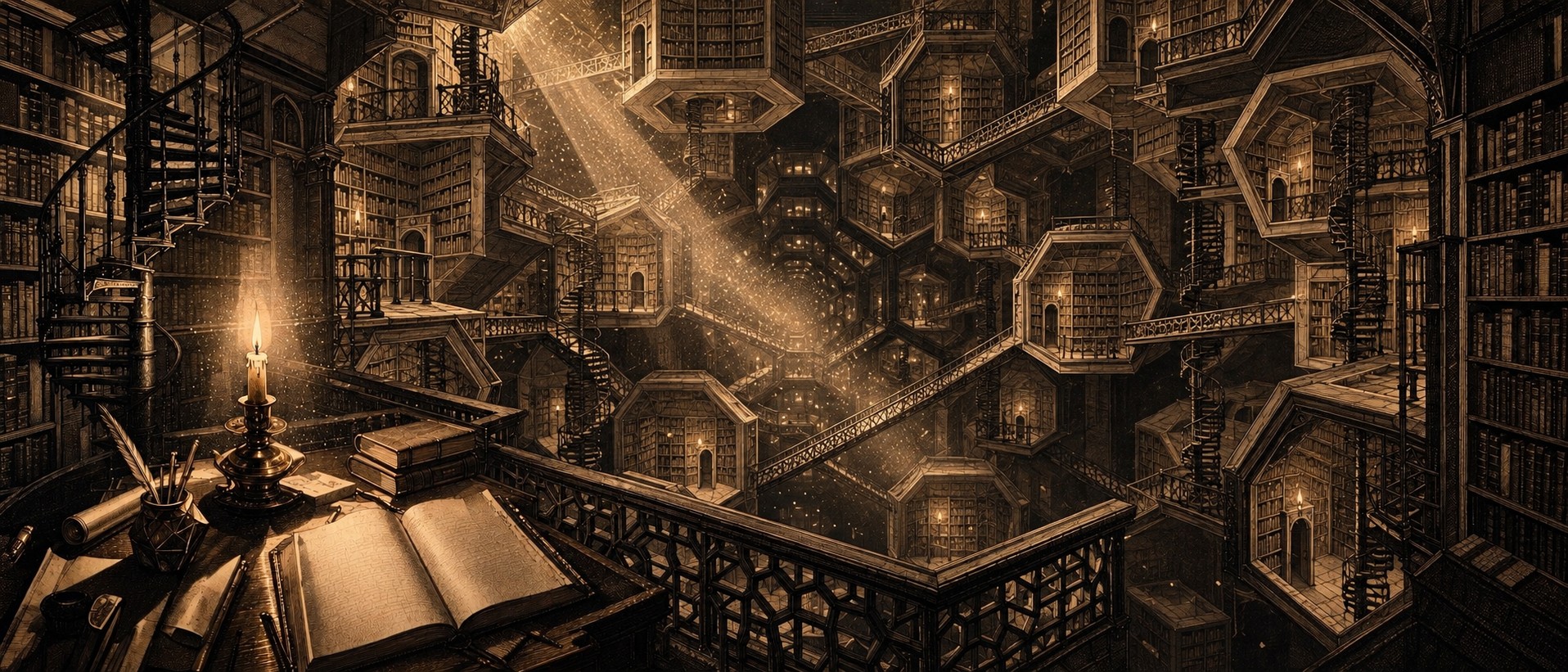
On Entering
There is, somewhere—perhaps in a library you have never visited, perhaps in one you visit every night without remembering—a shelf that does not end. I do not say this to deceive you; I say it because it is, in a modest and verifiable sense, true. Borges did not write books so much as he confessed to having glimpsed them, already complete, in some other geometry of time, and then transcribed, with the humility of a copyist, only what the vertigo permitted him to recall.
You will find, in these pages, a man who dreams another man into existence and is troubled, quite reasonably, by what that implies about himself. You will find a garden whose paths fork not in space but in time, so that every choice you did not make continues, elsewhere, to be made. You will find a library built of hexagons, infinite or merely unimaginably large—the distinction, Borges suggests, may not matter to those who live and die within it. You will find mirrors that are feared for a reason no one quite states aloud, and you will find, disguised as a scholarly footnote, an entire heresy.
None of this is fantasy in the ordinary sense. A tiger appears, now and then, in these stories—not as a symbol to be decoded, but as a tiger: orange, real, and somehow always just out of reach of the sentence trying to describe it. This is the peculiar honesty of Borges: he does not ask you to suspend disbelief. He asks you to notice that disbelief was never quite as stable as you assumed—that eternity, infinity, and identity are not mystical furniture but ordinary words whose edges, examined closely, dissolve.
The prose itself is spare to the point of austerity. There are no crowded rooms here, no overwrought feelings described at length. Instead there is the clean line of an argument that turns out, three sentences later, to have been a trap—or a mercy, it is hard to say which, and that uncertainty is the point. Borges writes as a man drawing a map so accurate that he worries, quietly, in parentheses, about what happens to the territory.
I will not tell you how any of these labyrinths resolve. I will say only that each is built with an exit, and that the exit is rarely where the entrance led you to expect it. Read one story before sleep and you may find, on waking, that the distinction between the book and the room you read it in has grown, overnight, a little less secure. This is not a flaw in the reading. It is the book doing, patiently, exactly what it was built to do.