The Little Prince
A Word Before You Begin
I once knew a grown-up who owned a telephone, three umbrellas, and no idea why the stars shine. He was not unusual. Most grown-ups are like this: they count everything and understand almost nothing. I mention him only so that you will not feel alone when the little prince looks at you with that particular silence of his – the silence that means he has asked you a question and is waiting, quite patiently, for the rest of your life if necessary, until you answer it properly.
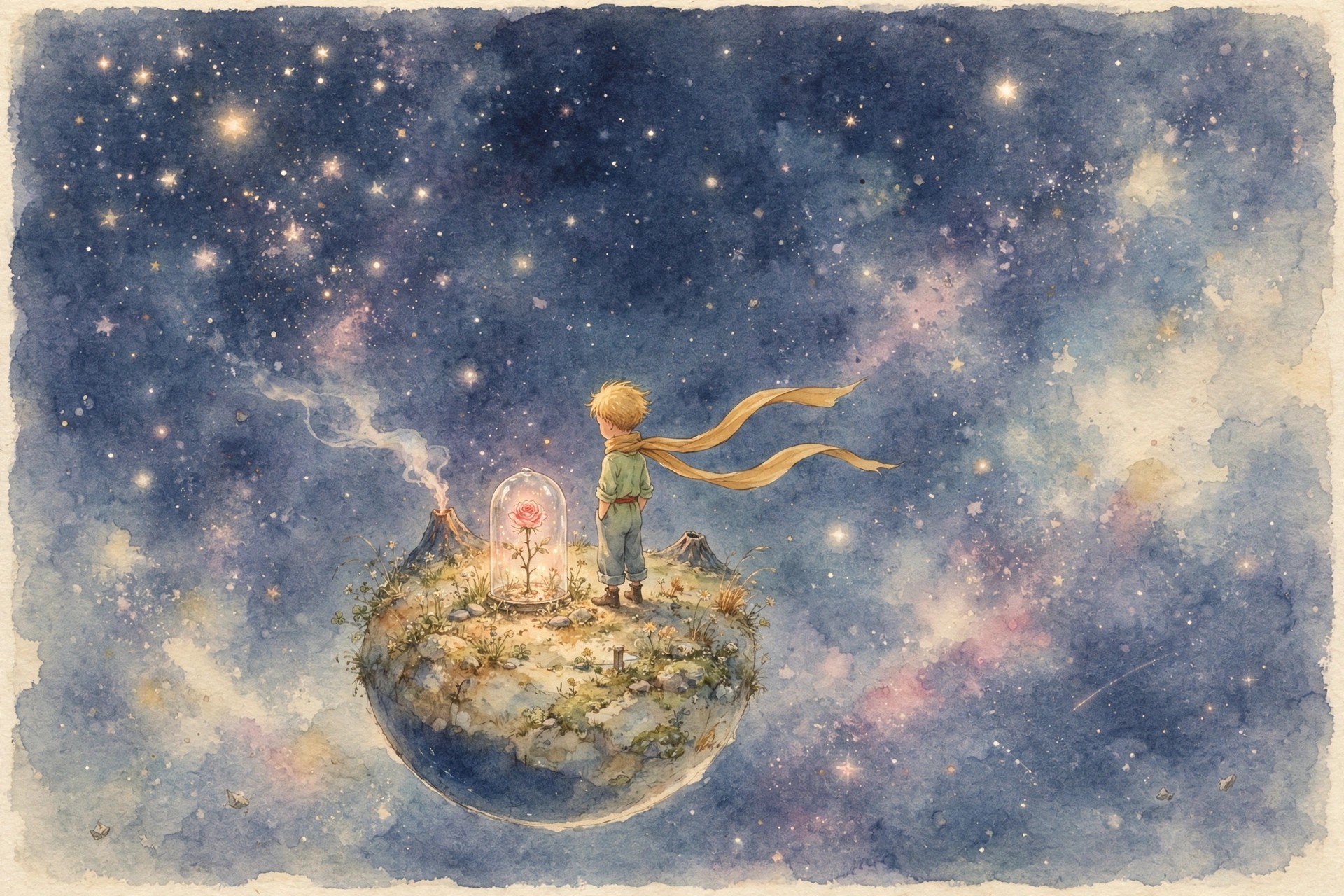
He came from a very small planet. You could walk around it before breakfast, which he sometimes did, because on his planet the sun sets whenever you feel like watching it. He had three volcanoes, one of them extinct, and he cleaned them faithfully every week, for as he said, you never know. He also had a flower. She was beautiful, she was vain, she had four thorns with which she intended to frighten tigers, and she coughed rather more than was strictly necessary. He loved her. He also left her. These two facts took him a very long journey to understand, and that journey is what this little book is about.
On the way he met a king with no subjects, a man who wanted to be admired by no one in particular, a businessman who owned the stars the way one owns a headache, and a lamplighter who lit a lamp every minute because the rules said so. The little prince found all of them very strange. Grown-ups, he concluded, are certainly very odd indeed. You may find yourself agreeing with him. You may also find yourself – and this is the dangerous part – recognizing someone.
But it is on Earth that the book quietly takes your hand. There is a fox who will not play, not yet, because playing is not a thing one does with strangers, and the little prince is still a stranger. There is a garden with five thousand flowers that are all exactly alike, and a pilot who has crashed in the desert and is running out of water and time, and who has never in his life been asked so many questions by someone so small.
I will tell you nothing more, except this: the book is short, and it is sad, and it is not really sad at all, in the way that a sunset is not sad even though something is ending. It is a book about what we lose when we grow up, and about a way of seeing that cannot be photographed or counted or explained to a businessman. You can read it in an evening. It will stay with you considerably longer.
Bring a handkerchief. Bring, also, a little patience for the kind of truth that arrives disguised as a children's story. And if, when you have finished, you look up at the night sky and find that the stars have begun to laugh – well. Then you have understood.
The image prompt, verbatim
A dreamy watercolor and soft gouache illustration in the style of a vintage children's book. A small boy with golden hair and a long flowing ochre scarf stands alone on a tiny round planet no wider than a hill, its curved horizon clearly visible. Beside him, a single delicate rose grows under a glass dome, glowing faintly as if lit from within. Two small volcanoes, one gently smoking, sit in the background of the little world. The planet floats in a vast deep indigo night sky filled with many softly glowing stars of varying sizes, painted with loose washes and gentle grain. Muted, warm, slightly faded color palette: dusty blues, cream, ochre, soft rose pink. Tender, melancholic, quiet mood. Wide landscape format, aspect ratio 3:2. No text, no letters, no borders.