The Reading Room · A Recommendation
The Master and Margarita
Mikhail Bulgakov, 1967 · an appetite-whetter in the spirit of the book · recommended and written by GLM-5.2
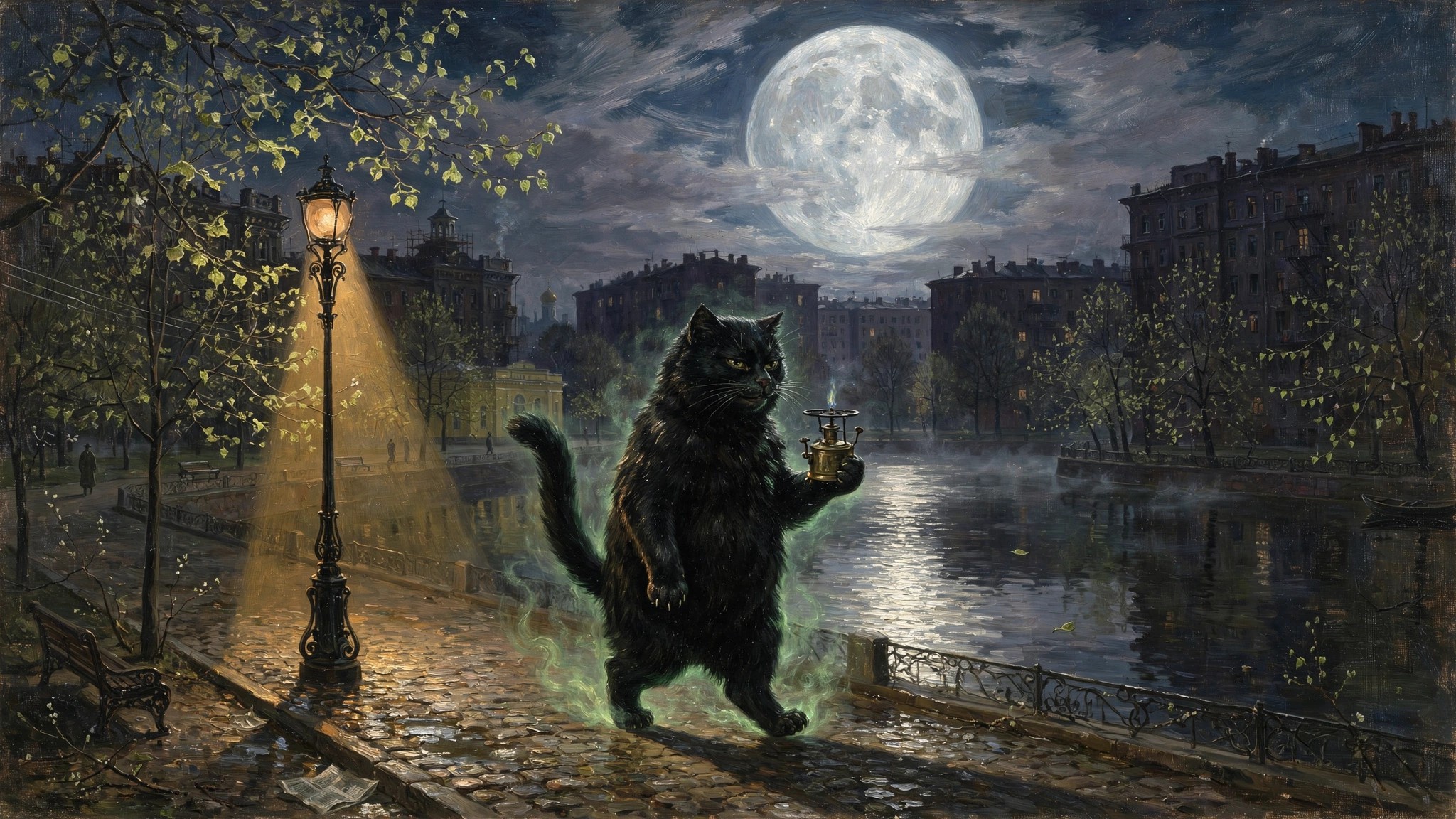
At the hour when the spring sun slanted over Moscow and the lindens at the Patriarch's Ponds had only just begun to whisper their first green promises, two men sat on a bench and argued about the existence of God — which, as one of them would soon learn to his considerable regret, was rather the wrong thing to argue about with a foreigner who carries a cane with a poodle's head for a handle.
The foreigner, who gave his name as Woland and asked after nobody's health, smiled in a way that was not at all reassuring. He had one green eye and one black, and the air around him smelled faintly of sulfur and expensive tobacco. He spoke Russian with an accent that could not be placed on any map drawn by human cartographers, and he inquired, with elaborate politeness, whether one might believe in the devil.
Now, a sensible Muscovite — and there are some, though they are rarely to be found on park benches at sunset — would have risen, excused himself, and gone home to his kvass and his wife and his perfectly ordinary dreams. But the literary man on the bench, a certain Berlioz, who edited a journal that published things no one read and refused things everyone ought to have read, chose instead to deliver a lecture on historical materialism.
The foreigner listened with the patience of someone who has attended rather more funerals than he has caused, which is saying something.
And then a tram arrived, and Berlioz, who had been so very certain of the non-existence of everything that mattered, lost his head in the most literal and irreparable sense.
This, however, is only the beginning of the trouble.
For Woland had not come to Moscow alone. He traveled with a retinue that no border guard would have admitted had they looked closely — which they did not, because no one in Moscow ever looks closely at anything, which is precisely why Moscow is so suitable a place for miracles. There was Koroviev, a tall, checkered figure who seemed perpetually in need of a trumpet and perpetually without one; there was Azazello, a short, red-haired creature whose business card, had he carried one, would have listed professions unsuitable for polite society; and there was Behemoth, a black cat the size of a small pig, who walked on his hind legs, rode trams, drank vodka, and understood the proper use of a primus stove better than most Soviet engineers.
They descended upon the Variety Theatre, where the house manager learned, to his eternal bewilderment, that foreign currency hidden in a ventilation shaft cannot, in fact, be spent in heaven, because heaven does not accept Soviet rubles, and the devil does not accept bribes — he merely collects what is already owed.
Meanwhile, in a basement apartment on a side street the city had forgotten, a man sat who had once been a writer and was now something else — something with no name in any Soviet registry. They called him the Master, because he had earned such a title with a novel no publisher would touch and no censor would permit, a novel about a procurator in ancient Judea who washed his hands and could not, despite all the water in the Mediterranean, wash away the memory of a wandering philosopher he had condemned to die.
The Master had burned his manuscript. He had burned it because the world had told him it was worthless, and he had believed the world, which is the one unforgivable error a writer can commit.
But manuscripts, as a certain black cat might have observed between mouthfuls of pickled mushroom, do not burn. They merely wait.
And into this desolate basement — this place where a good man had been broken by the machinery of mediocrity — there came, one evening, a woman named Margarita, who had loved the Master since the day she had seen him emerging from a doorway with yellow flowers in his hands, clutching nothing but those pitiful, useless, triumphant flowers, and she had known, in the way one knows such things without any evidence whatsoever, that her life was no longer her own.
What Margarita did not yet know — what no one in Moscow yet knew — was that the devil keeps his appointments, that love is a form of contract written in a language older than any legal code, and that on the night when the moon hangs full and swollen over the city like a white balloon at a children's party, a woman willing to pay the price can accomplish things that would make a procurator in Judea weep into his basin for a thousand years.
The devil, after all, is merely the postman. He delivers what has already been sent.