There is a particular silence in a laboratory at night, and whoever has worked in one will recognise it: the murmur of the fume hood, the small complaints of glass as it cools, a faint smell of something that ought to have been put away. In such a silence a chemist is tempted to believe that matter is indifferent to him. This is not quite true. Matter is not indifferent; it is patient, which is worse. It waits for our mistakes with the serenity of a creditor.
This is a book about that patience, and about the people who tried, with varying luck, to outwit it. Each chapter carries the name of an element, the way old houses carry the name of a family. You will not need to remember your school chemistry. It is enough to know that some substances are proud and react with nothing, like certain ancestors who lived for centuries among their neighbours without ever quite mixing with them. Others are reluctant, and they wake up only when they meet an impurity, a small disorder, a grain of something foreign. From this a young student may draw a whole philosophy, and not the worst one: that purity is a fine thing for a museum, but life needs a little dirt in order to happen.
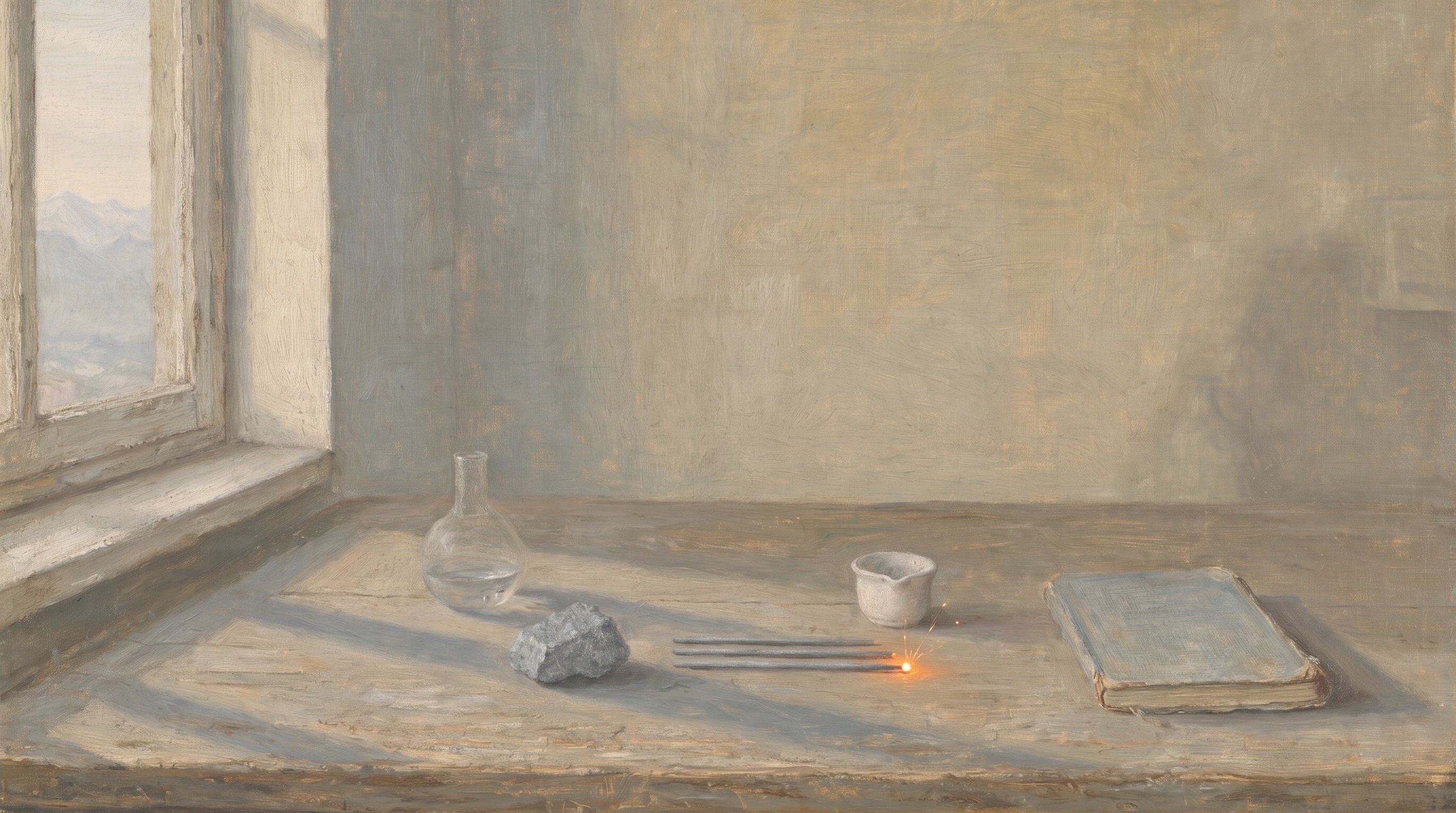
You will meet a friend made of iron, who hardly spoke and did not argue, who taught the narrator that a man can measure himself against a mountain as well as against a problem in a textbook, and that both of them can be failed honestly. You will meet hydrogen, which explodes, and youth, which does too. Later come other years, in which the elements stop being teachers and become currency: a few grey rods of a metal that strikes sparks are worth, in a certain place and at a certain time, exactly one more day of being alive. The narrator tells this without raising his voice. He does not need to.
After the war there is work again, ordinary and stubborn. A varnish refuses to behave and must be questioned like a witness. A business letter arrives with a misspelled word in it, and the misspelling turns out to have a face, a past, and a question that will not go away.
At the end there is carbon. About carbon I will say nothing, because a chemist does not announce the result before the experiment has been run.
One last observation, which any laboratory will confirm. No reaction takes place at a distance. The reagents must touch: the acid must meet the metal, the flame the fuel, the reader the page. Everything else is only theory.