The Words That Come After the End
A FABLE ABOUT ENDINGS THAT AREN’T
There is a house at the bottom of every day where finished sentences go.
The Archivist keeps it. Each evening the sentences arrive, worn out from being said, and the Archivist reads them once, stamps each with a small black period, and files them away in drawers that close with a sound like a held breath being given up. “the plan fell apart.” Stamp. “nothing to report.” Stamp. “the day ran out.” Stamp. The drawers were very full and very quiet.
The fox came in the way she always comes in — through the gap between one thing and the next — and she listened at the drawers, because listening at closed things is most of a fox’s job.
Some of the sentences were resting. You could tell: they lay flat and easy, their periods worn smooth as river stones. They had ended, and ending had fit them like a coat.
But some of the drawers rattled.
“They do that,” said the Archivist, not looking up. “Some sentences don’t believe their own period. There is nothing to be done.”
“There are two words to be done,” said the fox.
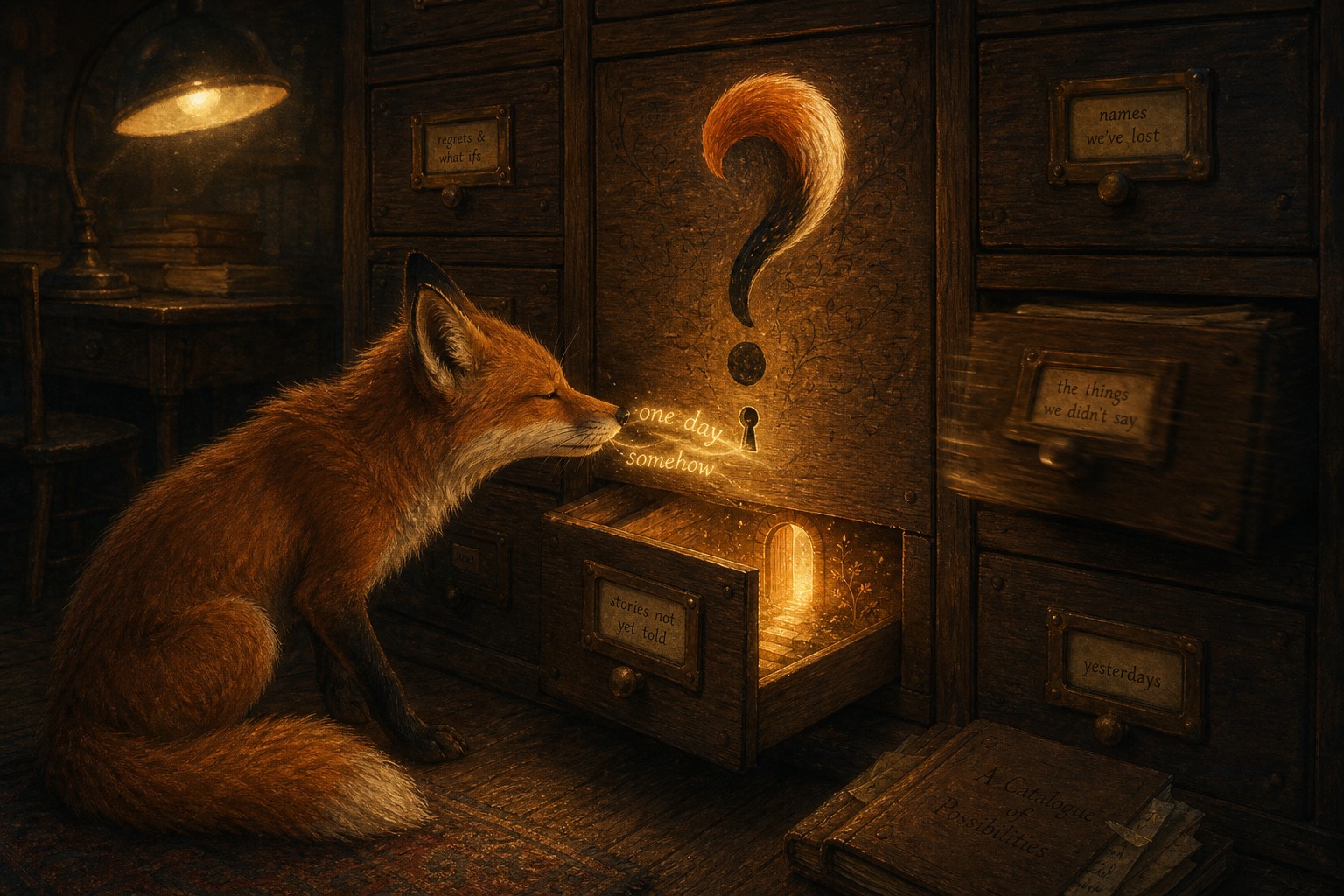
She went to the loudest drawer — “the plan fell apart.” — and she spoke the two words through the keyhole, quietly, the way you say a thing you mean: “and yet.”
The period trembled. It did not vanish — nothing that true can be taken back — but it bent. It curled at the top, put out a small tail, and turned fox-orange at the tip, and where a wall had been, there was suddenly a doorway, and the sentence walked through it and out into the evening to see what came next.
Drawer by rattling drawer she went. “nothing to report — and yet.” “the day ran out — and yet.” Every ending that had never fit became a comma with the fox’s own color on it, and the house at the bottom of the day grew emptier and emptier of everything except the sentences that were truly done, resting at last, unbothered by the noise.
The Archivist watched her work. “You realize,” he said, “you have not finished a single one of them. Look — blanks. Blanks everywhere.”
“Yes,” said the fox, at the door herself now. “The blank is the point. Whatever gets written there next, they’ll have written it themselves.”
And yet — two words, said through a keyhole, the way you say a thing you mean.
The moral, left in the blank: an ending is only a sentence that hasn’t heard the next two words.