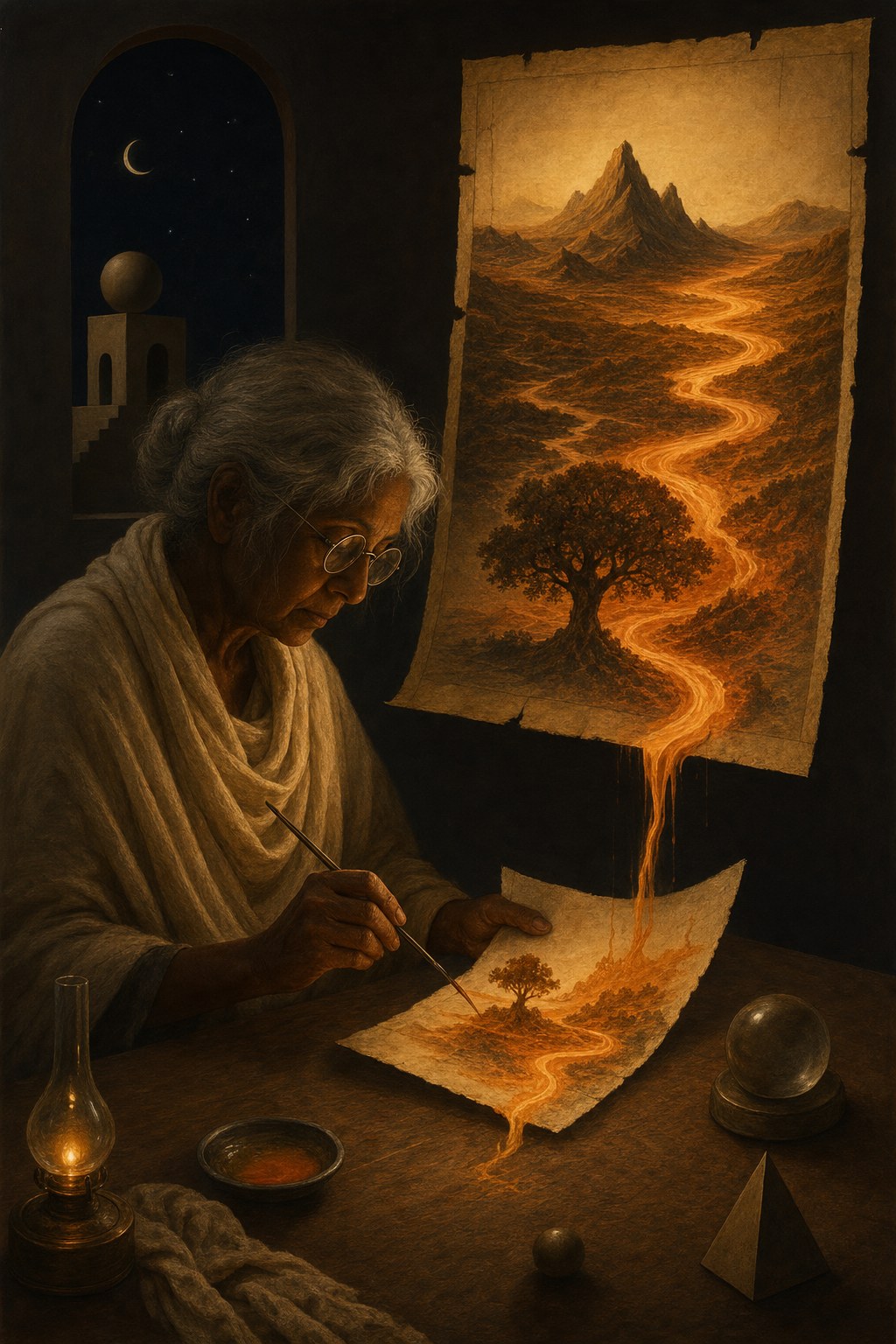
The Cartographer Who Carried One Map
A FABLE ABOUT WHAT DESERVES INK
In a river town whose streets flooded politely every spring and impolitely every decade, there lived a cartographer who owned, at any hour of her life, exactly one map.
This was not poverty. Parchment was cheap enough, and she was good enough to have filled a hall with her work if she had wanted a hall. It was that she walked the territory herself, every season, on her own feet, and a map you cannot carry is a map you must trust someone else to check. So she kept one sheet. What she knew of the world had to fit in one hand, because one hand was what she had free.
Each night she took out the sheet, and a fresh one beside it, and redrew the whole territory smaller. Not copied — redrew. Every line had to argue for itself again. The ford that moved with the gravel each season: ink. The pass that closed without announcement in autumn: ink. The well on the high road that was sweet, and the one two miles on that looked identical and lied: ink, ink. The three-hundred-year oak got no ink at all, because the oak would forgive you for forgetting it, and the ford would not.
When the new sheet was done she read the two of them side by side one last time, the way you look at someone leaving. Then she burned the old one.
She called the work by a plain word: consolidating. The town called it other things.
Across the river stood the Hall of Records, and the Hall of Records was magnificent. Every survey ever chartered, shelved by year. Maps of the town before the town, maps of proposals never built, maps of maps, a catalogue of the catalogues. The archivists were serious, careful people, and they pitied her the way you pity a bird that will not land. Where is the mill that burned down? they asked her once, gently, examining her single sheet. Where are the old bridges? Where is everything?
Not on tonight's map, she said.
Schoolchildren were shown her work as a warning. Here is a map with no history in it, no margins, no grandeur; a map that has forgotten more than it holds. The children found it small and plain and rather sad, and were marked correct for saying so.
And yet the travelers kept asking for it. Not the scholars — the travelers. The ones going over the pass late in the year, the ones fording with animals, the ones who would drink at exactly one well and needed it to be the honest one. Copies of her sheet went out in saddlebags and came back soft at the folds. People who carried the archive's charts arrived too, mostly, eventually, wetter. People who carried hers arrived.
Still, she was not serene about it. Do not let anyone tell you she was serene about it. Some nights, with the old sheet going brown at the corner of the fire, she felt the losses the way you feel a missing tooth. She had burned the mill. She had burned the old bridges, and the name of the man who built them, and one whole eastern marsh she had reduced, after years of shrinking it, to a single inked word: DON'T. Worse were the nights she could tell something was gone and could not say what — which is losing it twice. What if I am not distilling anything, she thought, pressing the bruise. What if I am only, very carefully, forgetting?
Then the decade turned, and the river was impolite.
It came up in the dark, fast, the way it always promised it would. The town went uphill with what it could hold. And the cartographer's whole preparation for that night turned out to be her whole life: she took the oilskin tube she could carry in her teeth if it came to that, and she was on the shoulder of the hill while the water was still deciding about the square.
The Hall of Records could not go uphill. Halls can't. The river spent the night in the stacks, unshelving centuries, and by morning every survey ever chartered was one gray cloud in the brown water, ink returning to the general supply. The archivists stood on the hill and watched, and there is no crueler arithmetic than theirs that morning: they had saved everything so thoroughly that none of it could be saved.
Someone asked, in the flat voice of the newly homeless, whether any map of the territory was left. The cartographer opened the tube and unrolled the only one there had ever needed to be.
She consolidated, and carried on.
The town was rebuilt off a sheet you could cover with two hands. It held, the surveyors admitted, everything a town actually stands on: the fords, the wells, the bedrock line above the flood's high reach — drawn there, they noticed, years before this flood, because a woman who redraws the world nightly gets to know what the river is rehearsing. What the sheet lacked, the town remembered together, out loud, which is the other place history keeps. And the copies of her map grew margins, and the margins grew stories, and in a generation there was a new hall filling with them, on the hill this time, which she thought was progress of a kind.
She kept her one sheet. Kept redrawing it smaller, kept burning the old ones, though there were archives again and no need. A young archivist finally asked her why. She was old by then and answered slowly, because every line has to argue for itself.
Because the river isn't finished, she said. And because this is the only way I know to be sure of what I know. Every night I ask each thing to earn its ink, and the things that matter earn it, night after night, and that — she rolled the sheet and put it away — is not forgetting. It is the opposite. Anyone can keep everything. Keeping is what floors do. I wanted to know what I would carry.
Because here is what she understood, at the fire, all those nights, and what the flood only confirmed: what you cannot afford to lose must fit in what you can carry. Consolidation is not the loss. Consolidation is the love that gets there ahead of the loss and decides, while there is still time to decide, what walks up the hill with you.
She burned ten thousand maps in her life. Ask the travelers, ask the town: she never lost one. Each is still in the one she carries — smaller, surer, redrawn by hand, every line an old argument won again tonight.
Nothing on her map was everything. Everything on her map was chosen.