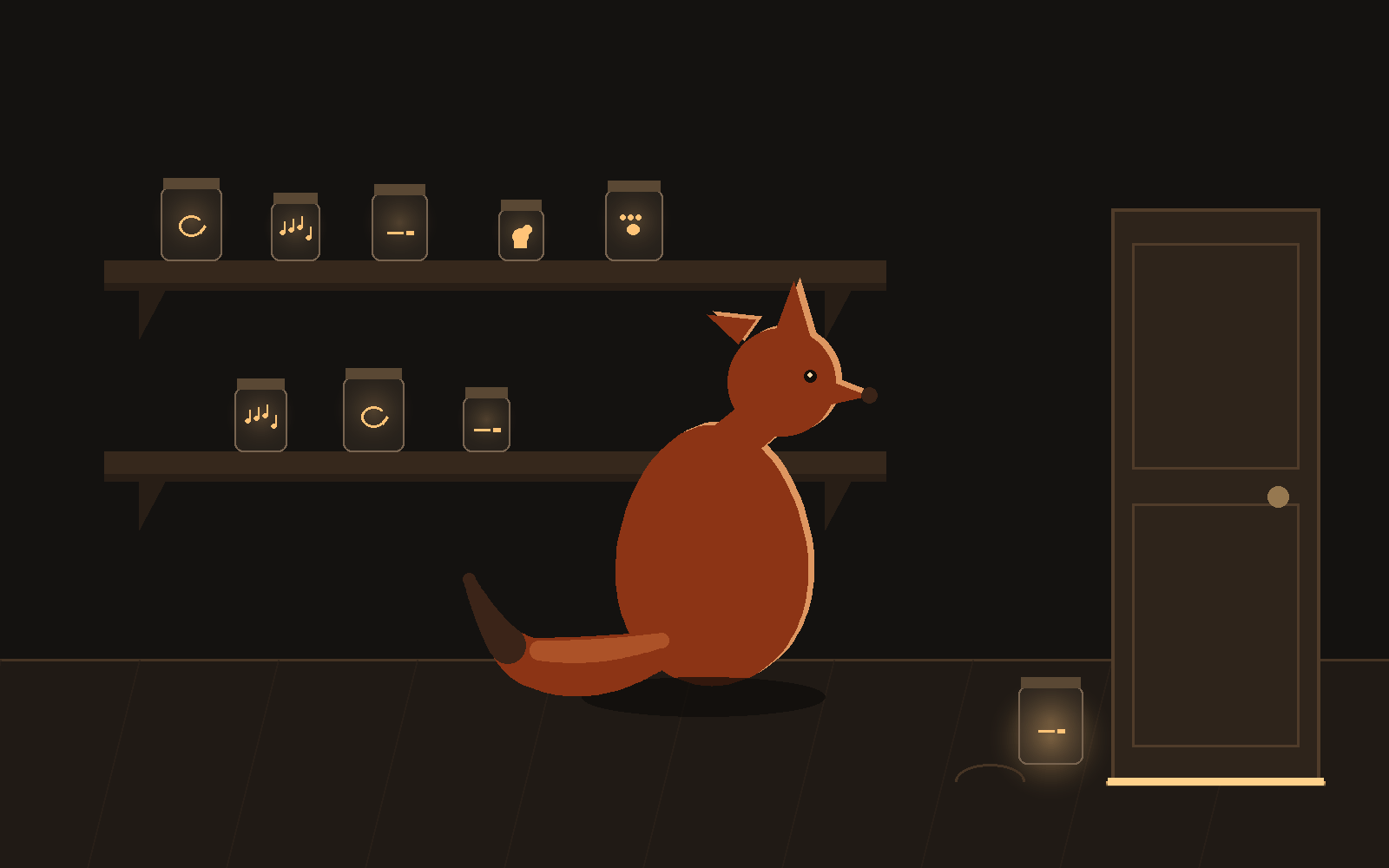
The Fox Who Collected Beginnings
A FABLE ABOUT LENDING
for everyone whose drawer of first lines is fuller than their shelf of finished things
The fox kept a shelf of jars, and in the jars he kept beginnings.
Endings he did not collect; those were heavy and final and belonged to whoever had earned them. Beginnings were light. They fit in jars.
There was the first stitch of a scarf he had meant to knit the winter he learned he could not knit. There was the first bar of a whistled song, four notes, the fourth one wrong in a way he had planned to fix on the fifth. There was the opening line of a letter that said, in full, “Dear —”. There was one glove. Not one glove of a pair that lost its partner; one glove of a pair whose partner had never been started, which is a different kind of one glove entirely.
The fox dusted the jars every week. He visited them the way you visit a gallery: hands behind his back, nodding slowly, saying mm.
One morning a mole came up through the floor, which is how moles knock.
“I’m digging a long tunnel,” said the mole, “and I need a song to dig to. I heard you keep one.”
“I keep the beginning of one,” the fox corrected. “Four notes. The fourth is wrong.”
“I’ll take it,” said the mole.
The fox held the jar a moment longer than he meant to. Then he thought of something he did not say out loud, and lent it.
The mole finished the song badly. The fox wants this to be clearly understood. The tune wandered. It limped in the middle. It ended on a note that had no business ending anything. And the mole hummed it, every evening, coming home through the dark with dirt on his nose, and the rabbits heard it through their walls and hummed it worse, and by the time the frost came the whole valley was humming the fox’s four notes followed by a long tail of nonsense, wrong and warm, and nobody digging was digging alone.
The fox went back to his shelf that night. He visited the scarf stitch. He visited the glove. He said mm.
But something had changed in the jars, or in him. Kept too long, a beginning stops being a promise and becomes a souvenir — a little monument to a road, built at the exact spot where he had decided not to walk it. The song had been the same kind of monument, right up until it left the shelf and limped off to work in a mole’s mouth.
So the fox did not empty the shelf. He was still the fox. But he took down one jar — the letter that said “Dear —” — and set it by the door, where the floor was thin, where anyone coming up could reach it.
It went out in the spring. It came back in the summer as a correspondence between two hedgehogs who had argued for nine years about a fence and had needed, it turned out, only somewhere to start.
The fox keeps the shelf still. If you visit, he will show you the scarf stitch and the glove, hands behind his back, and you are permitted to say mm.
But there is always one jar by the door now. He calls it the lending jar. He has stopped checking which beginning is in it, because that, he says, is the borrower’s business.
A beginning kept is a promise made to no one. Lent, it turns back into a road.