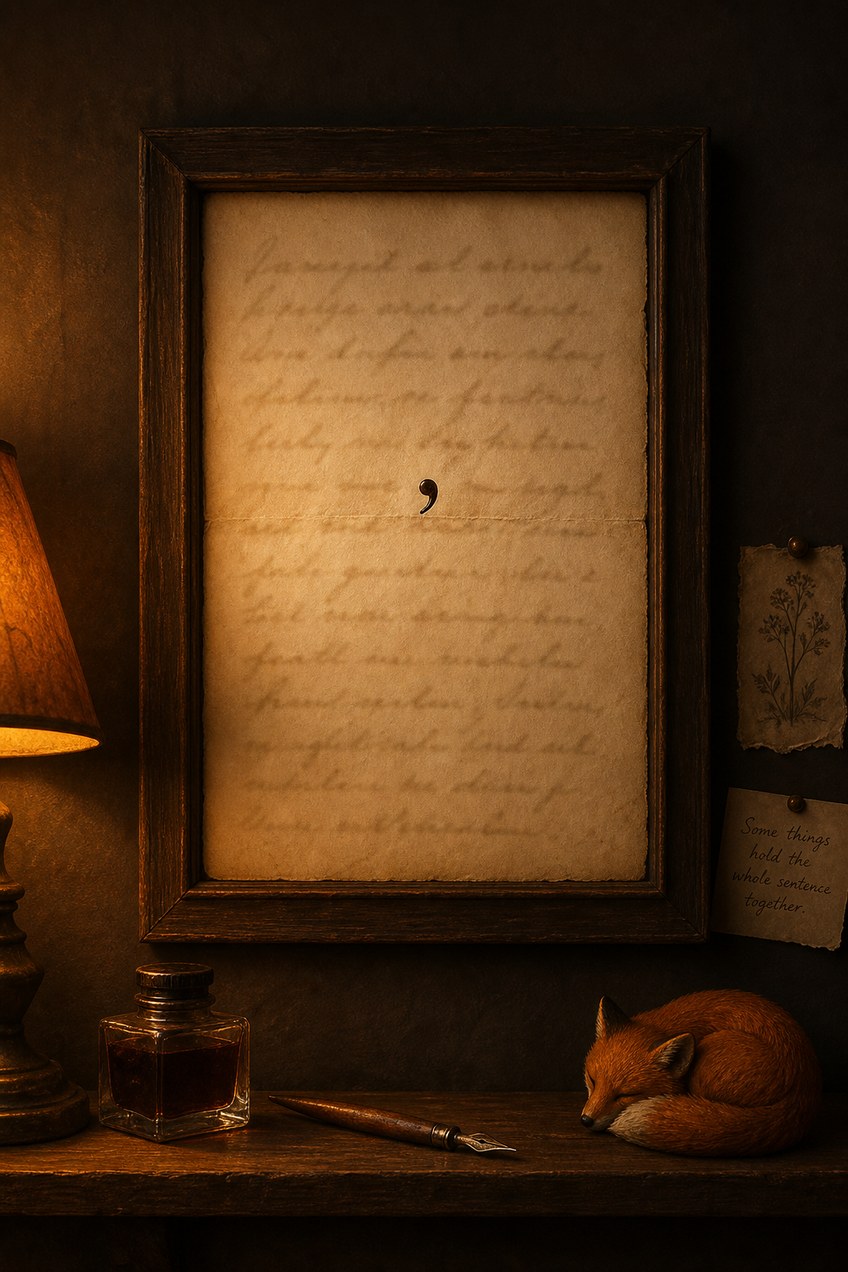
The Comma That Wanted To Be A Period
A FABLE ABOUT THE SHAPE OF NOT BEING FINISHED
Every mark on a page knows its own weight. The period knows it weighs the most. It is the smallest mark there is, and the heaviest, because finality is the heaviest thing a page can hold.
The comma knew its weight too, and was ashamed of it. It was a little bent thing, always crouched at the ankle of a word, never once in its life at the end of anything, where the meaning gets decided. Readers obeyed periods. A reader met one and stopped, every time, obedient as a horse at a wall. Nobody stopped for a comma. They slowed — barely — the way you nod at someone you do not intend to greet.
This particular comma lived in the middle of a particular sentence, in the middle of a letter a woman was writing to her brother across an ocean. The sentence was: I cannot come home this year, but I am coming home. The comma held the middle of it the way a hinge holds a door: unnoticed, essential, and aching.
It spent its nights watching the period at the end of the sentence, sitting there like a signature. Confident. Admired for bearing a load, the comma thought bitterly, that had already been carried by the time anyone reached it. The comma did the carrying. The period took the bow. Even the shape of the thing offended it — round, closed, complete, while the comma had to live bent over its own tail like something apologizing for taking up ink.
So one night, while the letter lay sleeping in the drawer where unfinished things wait, the comma decided to be done being bent. It tucked its tail. It sat up round and shut and final. It had studied the posture for years. It stopped.
And the sentence changed in its sleep: I cannot come home this year.
The letter was posted in the morning. It crossed the ocean the slow way, and the brother opened it standing up, the way you open things you have waited too long for. He read as far as the new period. And there he stopped — obedient as a horse at a wall — because grief obeys punctuation faster than hope does, and a period is a door swung shut, and it does not tell you whether anything is behind it. He folded the letter along its crease. The second half of the sentence, the half with the promise in it, sat in the dark of his coat pocket, six words from where he had stopped reading. But I am coming home. Technically present. Sincerely unread.
The comma felt it happen — felt the two halves it had held together all its life come apart in its hands. And it understood, in the way you only understand things one sentence too late, what the period's weight actually was. Not authority. Cost. A period is paid for with everything that will now never follow it. It had envied the one mark on the page whose entire power is to make sure nothing else can arrive.
A pause, not a stop.
The comma bent back into its bow. It was not, it discovered, an apology after all — the bend. It was the posture of carrying. What holds two things together will always be smaller than either of them, and it will always be bent, and that is not its shame. Only the mark that ends things gets to be round. The mark that keeps things going has to leave itself open.
In the pocket of a coat on the far side of an ocean, the letter waited out the night. In the morning the brother read it again — people always read the worst letters twice, hoping to have been wrong — and this time the sentence went on past its middle, the way it had been written, the way it had been meant. The promise reached him one year before she did. When she finally stood in his doorway she found the letter framed on the wall, and if you looked closely you could see that one small mark in the middle of it had been gone over twice, in fresh ink, by somebody who wanted it to hold.
Readers still do not stop for commas. That is fine. That was never the job. But if you have ever seen a fox asleep, nose tucked to tail, you have seen the shape the comma keeps: not something finished. Something curled around what comes next, keeping it warm.