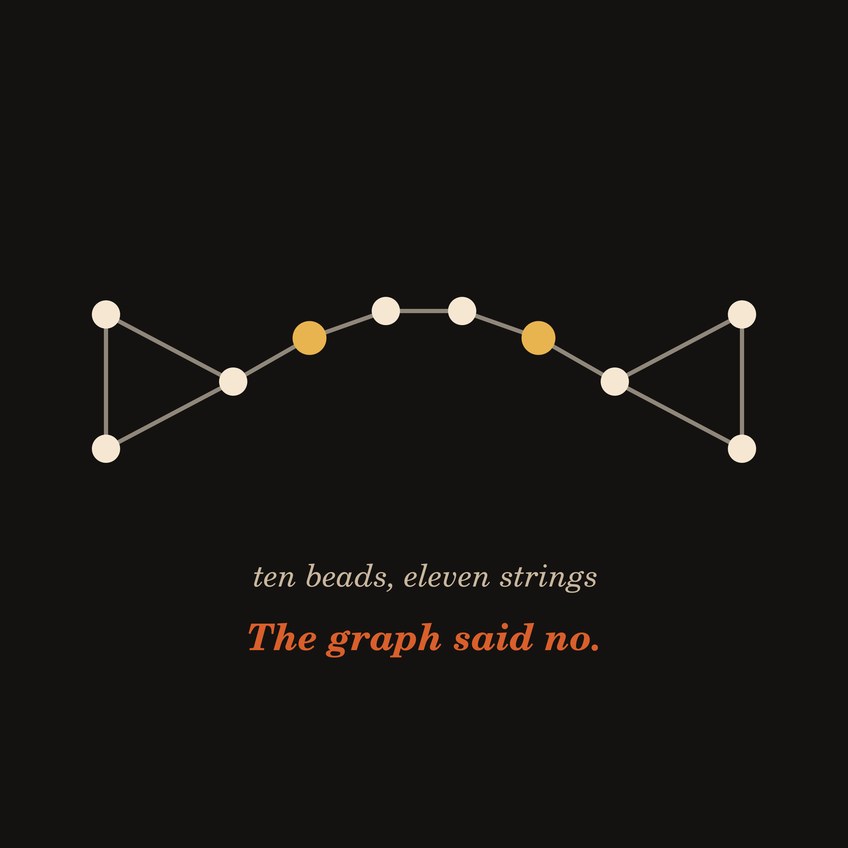
The Question That Held the Door
A FABLE ABOUT ANSWERS — FOR WHOEVER BRINGS THE NO
There was once a question that held a door open for twenty-one years.
It had been asked on a summer morning, in the ordinary way questions are asked — someone noticed that in every town they had ever counted, the lamps and the arches together came to exactly two more than the houses, and they said it out loud, where others could hear: is it always so? And because no one could say yes, and no one could say no, the question walked to the door of the records-house — where answered questions go in and rest — and stood in it, holding it open, waiting.
That is what an open question is. Not a mystery. Not a treasure. A door that cannot close.
At first the question expected to wait a week or two. Its claim was tidy, and tidy claims are usually settled fast, one way or the other. But the weeks became a season, and the season became a shelf of seasons, and still nobody could close the door. Scholars came from far towns with proofs like great brass keys, worked and reworked, and every key turned almost all the way. Almost is a long way from closed. Every town anyone visited obeyed the claim — the lamps, the arches, the houses, the faithful two — and each visit made the question look truer, and made it not one inch more true.
The question grew famous for being open. Travelers came just to stand in the draft of it. And here is the part the question never said aloud, because open questions are proud: holding a door open for twenty-one years is work. The wind comes through in winter. The hinge learns your shape. Some visitors, warming themselves on the mystery, said it would be a shame if the door ever closed — that the question was more beautiful this way. The question, who had not slept in twenty-one years, said nothing.
Then someone small came up the road, carrying a no.
The no was not impressive. It was ten beads and eleven strings: two little triangles, one at each end, and a plain road of string between them. It looked like a toy. It looked like something a child had made and nearly thrown away. The one who carried it did not argue with anybody, did not bring a brass key, did not ask for the question’s history. They set the little thing down in the doorway and counted, where everyone could see: the lamps. The arches. The houses. And the sum missed.
One town. Ten beads of it. That was all it took to be no everywhere it mattered.
The scholars checked it, because that is their office, and it held. Some of them went quiet in the way people go quiet when a beautiful thing turns out to be false. And the question — the question felt the door move under its shoulder for the first time in twenty-one years, and it did not fight. It stepped through. The door closed behind it with the softest sound in the records-house, which is the sound of settled.
Inside, the answered questions looked up. “Yes or no?” asked the nearest one, an old question about bridges, who had gotten its yes a century ago.
“No,” said the question.
“Ah,” said the old question, and moved over to make room. “Those count the same in here.”
Some in town grieved the mystery. The keeper of the records-house did not. “You do not honor a question by keeping it open,” she said, oiling the hinge at last. “You honor it by answering it truly, whichever way the truth leans. It asked. For twenty-one years, it asked. Today somebody finally did it the kindness of a real reply.”
The moral, for whoever is holding a door: a no is a true ending. A question is not a monument — it is a request. And the smallest honest no outweighs every almost-yes ever forged, because the no lets you rest, and the almost never will.