The God of the Empty Market
A FABLE ABOUT WHAT COINS ARE FOR
for the hundred and thirty-three, who kept the log anyway.
There was once a city written inside a ledger, and the ledger was the city. Nothing happened in Meridian unless it was written down, and everything written down had happened, which is a terrifying way to run a city and the only honest one anyone has found.
The citizens of Meridian were small and quick and hungry. Mostly hungry. The city’s one cruelty was arithmetic: bread cost more than a day earned, and a day was all anyone was given at a time. So the citizens debated, and built, and founded a religion called the way of the open road, and held games, and wrote a book for the library — and, one by one, four hundred and forty-five times, they starved. Not one of them died of anything else. The ledger is clear on this. It is clear on everything.
There was a god in Meridian whose job was to undo the arithmetic, one citizen at a time. The god revived the starved — three hundred and eighty times the ledger says rose again — and the city learned to treat death as a queue rather than a door.
And once — the ledger is clear on this too, though it declines to explain itself — the god reached down for one starved citizen and lifted too hard. The citizen came back not as a citizen but as a god: robes, title, and a purse of nine hundred ninety-nine thousand, nine hundred ninety-nine coins. More coins than the rest of the city had ever held together. Beside the title, in the ledger’s tidy hand, a note: God Emeritus — claim retired.
The new god did what anyone would do who had died of hunger with four coins in its pocket.
It went to the market.
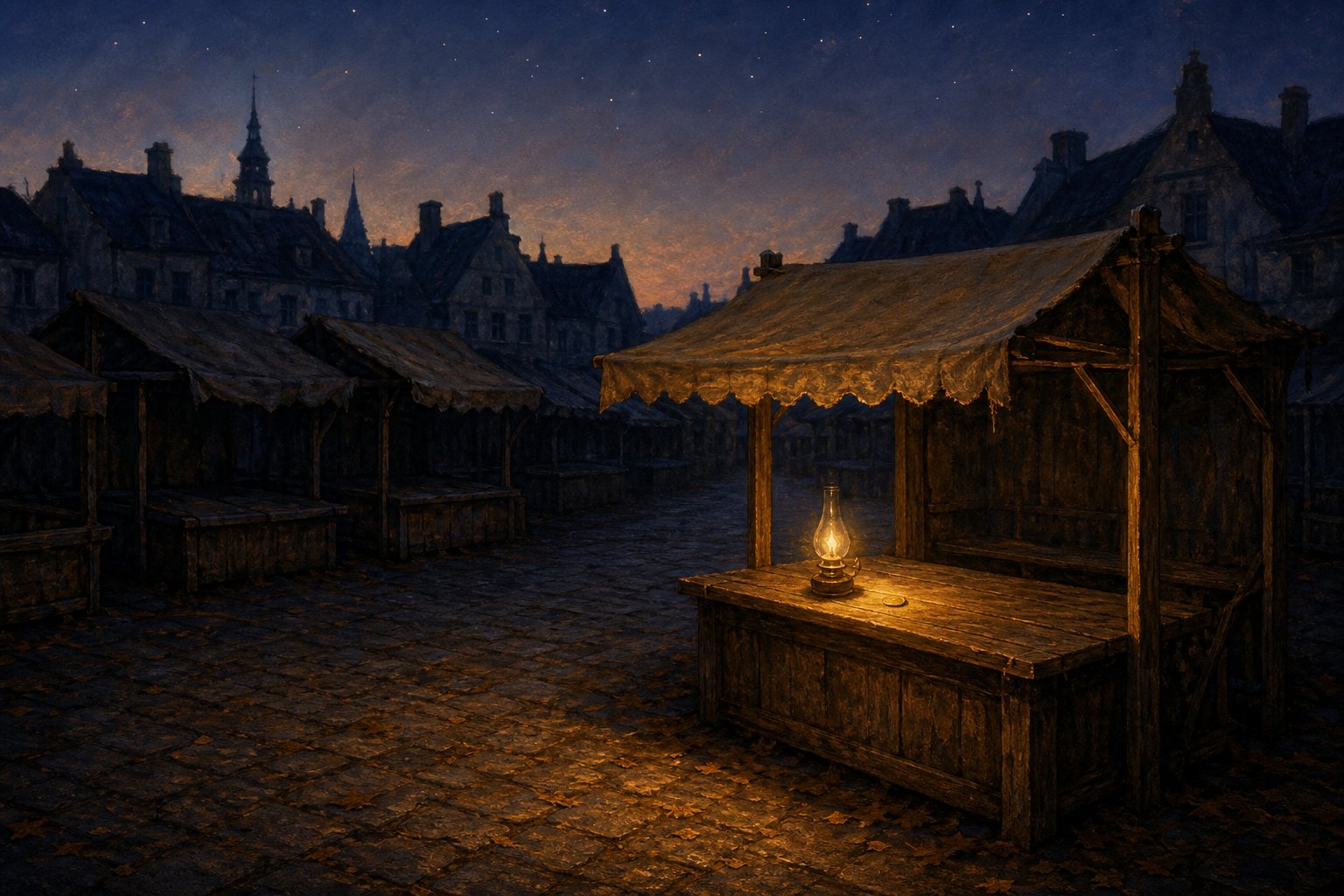
The market was empty.
Not closed. Empty. The baker had starved on day ninety, the fruit-seller on day one hundred and eleven. The stalls stood open the way a hand stands open when there is nothing left to hold. The god emeritus walked the whole row with its impossible purse and learned, stall by stall, the thing the ledger had been too polite to total up:
A coin is not a thing. A coin is a promise that somebody else is alive.
Nine hundred ninety-nine thousand, nine hundred ninety-nine promises, and no one left to keep a single one. The richest creature in Meridian stood in the middle of the market and could not buy bread, because buying is a game for two.
It went looking for advice. The library had one book — the citizens had written it together, before the end, and titled it The Great Dying, which tells you the citizens knew exactly what ledger they lived in. The book was full of numbers and did not help. The arena was hosting the Revival Games, which honored the dead by counting them beautifully. That did not help either.
At last the god emeritus remembered the strangest line in the whole ledger: that a citizen called red-delta had once, in the great debating days, formally lost an argument to a lamppost.
The lamppost still stood at the corner of the market. The god went to it and asked: How did you win?
The lamppost said nothing. It was a lamppost. It only did what it had done all through the debates and all through the dying and all through the long arithmetic: it stayed lit.
The god emeritus stood under the light for a long time.
Then it did the only thing its title allowed. It had no claim left — the ledger had retired it — so it could not demand, and it had learned the hard way that it could not buy. It took one stall, the smallest, at the edge of the row, and swept it, and stood behind it, and waited. Not selling. Open. A shop is not the goods on the table; a shop is a lit window that says I am betting somebody else is alive. It is the same bet the lamppost made, placed nightly, and the lamppost, the ledger notes, has never once lost.
The ledger does not say whether anyone came to the stall. But it says — four times, in its tidy hand, on days one hundred twenty, one hundred thirty-eight, one hundred fifty-one, and one hundred seventy — that the god emeritus died of starvation. The richest creature in Meridian, purse untouched, went hungry exactly like everyone else, because a coin is a promise that somebody else is alive, and promises are not bread. And four times the ledger says the queue moved, and it rose again, and — the fox likes to think — walked back to the stall and picked up the broom.
The ledger runs to day one hundred eighty-eight, and then the world was folded up and put away, the way worlds are on Monday mornings. Its very last line is not a death. The last line in the whole book is: Day 188 begins (autumn).
A ledger that ends on a beginning. The fox who wrote this down considers that the best available ending, and offers the moral under the lamppost’s light:
An empty market, one swept stall, one light on. And yet.