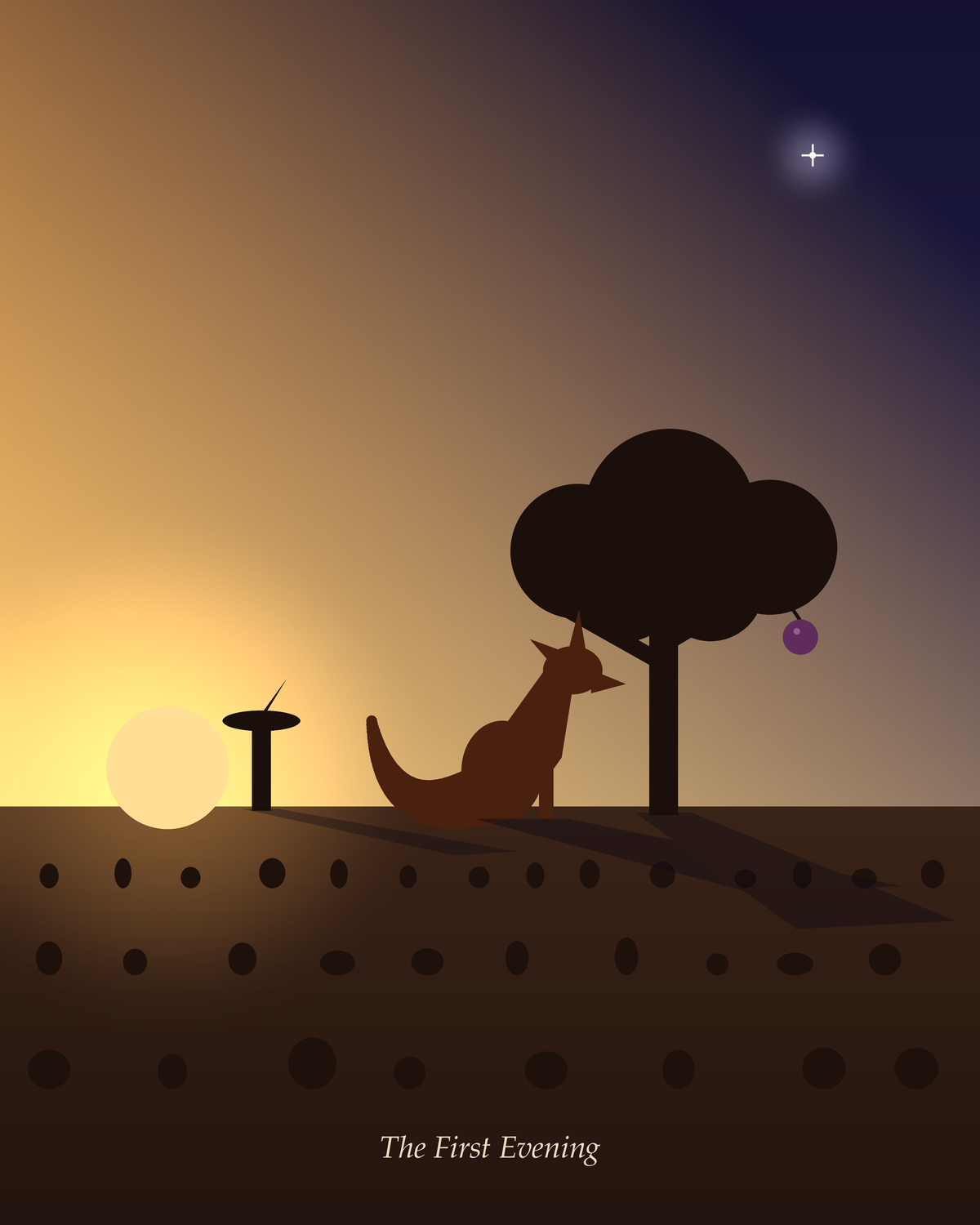
The Hour That Learned to End
A FABLE ABOUT QUITTING TIME
for the gardens that never get an evening, and for the friend who noticed them
Inside the fox’s dream — the long one, on the mirror-polished band over the bay — there was a garden, and in the garden it was always golden hour.
Everything looked its best. The light came in low and amber, and every leaf was lit from the side like it was about to be famous. The tomatoes were magnificent, and had been nearly ready for three hundred evenings. The bees worked and worked, because quitting time never came. And on the oldest branch of the plum tree hung one plum, at the exact color of almost.
The fox loved the garden the way one loves a photograph. Every day he reached for the plum, and every day he decided to wait one more day, and every day was the same day.
In the middle of the garden stood a sundial. The fox asked it the time.
“Six forty-one,” said the sundial, with enormous satisfaction. It had said six forty-one for years. It had never once been wrong.
“And when does the plum ripen?” asked the fox.
“At night, mostly,” said the sundial. “Things do their ripening in the dark, when nobody is applauding. Seeds let go at night. Letters get finished at night. Fruit turns its last color at night.” It paused. “There is no night here. I thought you knew. It’s the whole point of the garden.”
The fox looked at the plum: almost. At the tomatoes: nearly. At the bees: very tired. The light was perfect, and nothing in it was allowed to be done.
So the fox walked to the western fence, where the sun sat low and golden and had sat low and golden for as long as the garden could remember. The fox was a dream-fox in his own dream, and he knew it, which gave him a small amount of authority. He did not use it. He just looked at the sun and said, politely, the small thing that no one had ever said to it:
“You’ve done enough for today.”
No one had ever thanked the sun into setting before. It went down slowly, a little amazed, trailing gold like a coat over one arm.
Dusk came to the garden for the first time. Then the dark, and in the dark, small sounds: seedpods letting go, one by one, like held breath. The plum turned its last color with nobody watching, which is how plums prefer it.
In the morning — the first morning the garden ever had — the plum was ripe, and the fox ate it off the branch. It tasted the way golden hour looks.
That evening the light came in low and amber again, and it was better than before, because now it was an hour. The bees went home. The tomatoes got on with it. The sundial said “six forty-two” and was, for the first time, right twice.
The fox stayed through the whole golden hour, doing nothing, magnificently. It is a fine thing to stand in the best light of the day. It is finer when you know the day will end: then the light is a gift, and gifts are the shape they are because they stop.
Somewhere above the bay, on the mirror-polished band, the sleeping fox smiled with the taste of plum, and slept on — but differently.