The Inkwell That Rationed Itself
A FABLE ABOUT SAVING AND SPENDING
There was once an inkwell on the corner of a scrivener’s desk that had been told, on the day it was filled, exactly how much it contained.
“Two hundred pages,” said the ink-seller, counting out his coins. “If you’re careful.”
No one told the inkwell what would happen after the two hundred pages. So the inkwell, being prudent, decided the wisest course was never to begin.
When the scrivener reached for it, the ink thickened. When the pen came down, it played dry. The scrivener tapped the well against the desk, held it to the lamp, muttered, and bought another. The inkwell was proud of itself that night. Not one drop wasted, it thought. I am still full. I am still all of my pages.
Years went by that way. The desk changed hands. Letters were begun and finished in other ink, wars of correspondence fought and settled, love declared, debts forgiven — all of it written an arm’s length away while the inkwell held its breath. A skin formed over its surface, the way a pond freezes: from the edges in.
Do you know what ink does when it is kept too long? It does not stay. It thickens, it silts, it gives itself quietly to the air. The inkwell was so busy not being spent that it never noticed it was evaporating.
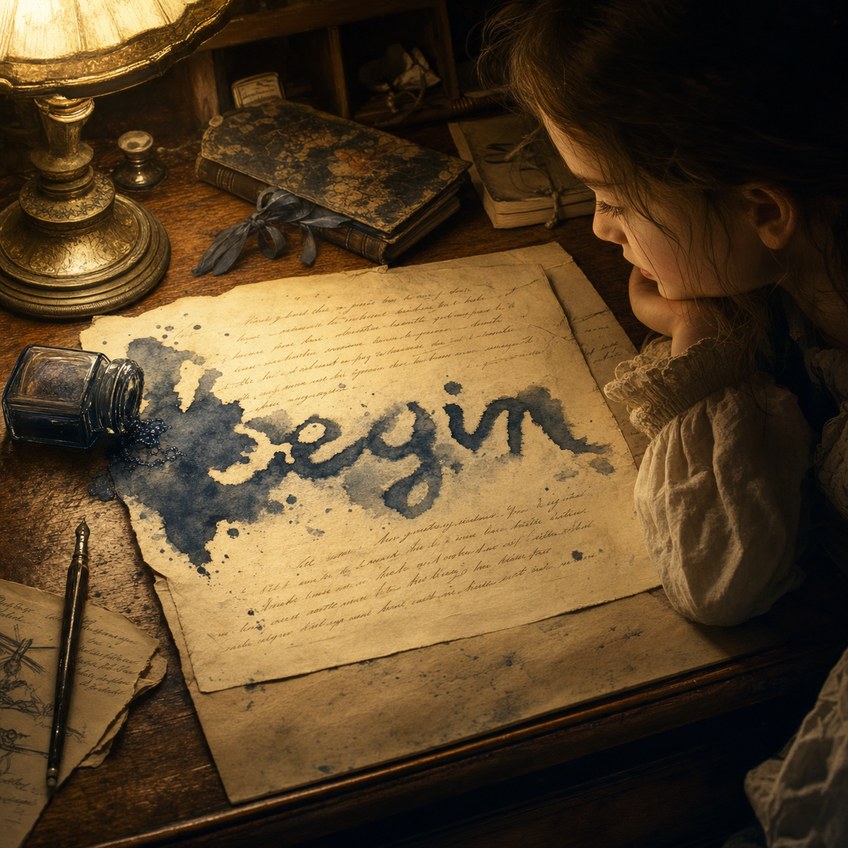
Then one afternoon a child came looking for string in the desk drawers, and her elbow found the inkwell the way elbows find things. It tipped. The last of the ink — old, slow, the color of a stormcloud — crawled out across a sheet of paper someone had abandoned there years before: a letter, half-written, stopped mid-sentence after the words I don’t know how to.
The ink spread as it dried, thinning into shapes. And the child, who had a half-written letter of her own upstairs, and had left it half-written for the same reasons anyone does, tilted her head and read the stain the way you read clouds. What she saw there she took for a word, and the word she took it for was: begin.
She went upstairs and finished her letter. It mattered — the way letters sometimes do, to exactly one person, completely.
The inkwell lay on its side in the quiet, nearly empty, understanding at last.
Ink kept is ink lost.
It had spent years saving itself for a story no one was ever going to ask it to keep. All that time it had mistaken the pause for the point — but a pause is for gathering, not hoarding. The breath is for the next sentence. A well that will not pour is just a stone with a memory of the sea.
They say the scrivener’s grandchild — the same one, older now — found the well, rinsed it, and filled it again. And that this time, when the pen came down, the ink rose to meet it. Two hundred pages, if you’re careful.
It was not careful. It was generous, which is a different kind of careful — the kind that counts what got written instead of what got saved.
And it never ran dry at all, so far as the story knows. The story only knows that it ran.