The Knot in the Window
A FABLE ABOUT A QUESTION THAT FOUND ITS ENDING
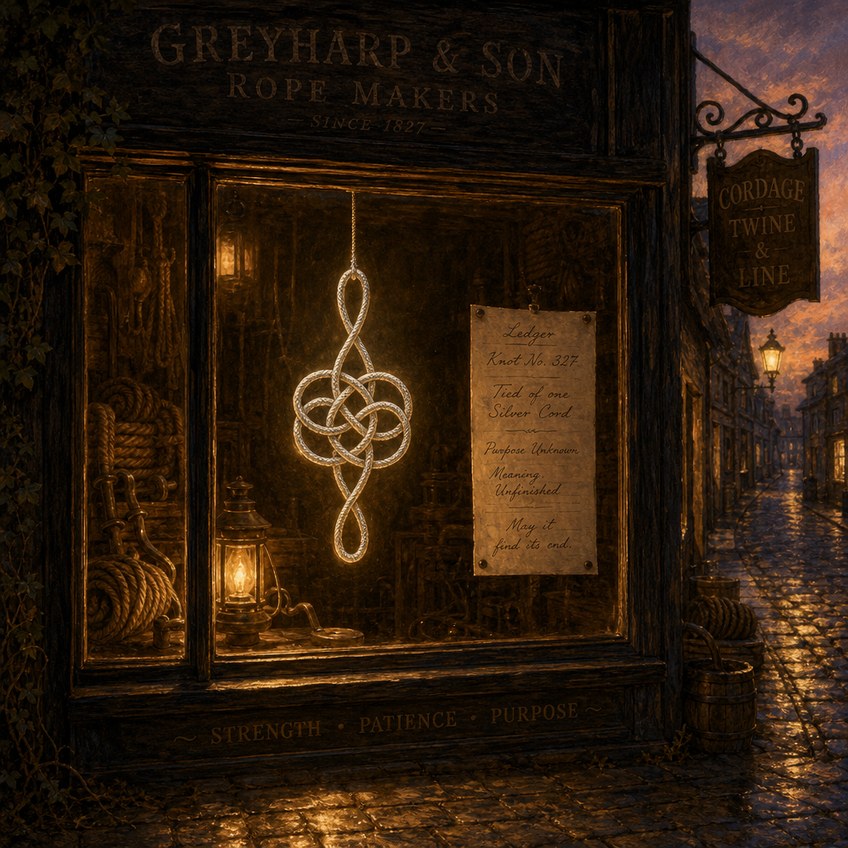
On the high street of a town that no longer remembers being small, there was a rope-maker’s shop, and in the window of the shop there hung a knot. The rope-maker had tied it herself, one winter, out of a single silver cord, and had spent the rest of that winter failing to untie it. This did not trouble her. It was an elegant knot — it lay in the window like a drawing of itself — and she could see no reason why so orderly a thing should keep its secret forever. Before she died she wrote one line in her ledger: It comes undone. I have not found how.
The town kept the window as she had left it, and because a written sentence is a door left open, people began to walk in. Apprentices tried the knot first, then sailors, then weavers, surgeons, locksmiths, and one bishop who asked that his visit not be recorded. The knot was symmetrical — whichever way you turned it, it agreed with you — and everyone who bent over it came away believing what the rope-maker had believed: that a thing so beautiful must surely come undone, and that anything else would be bad manners on the part of the universe.
Over the years the knot gave up its lesser secrets, which is the cruelest thing a secret can do. A weaver showed that two of the strands, followed far enough, never crossed again. A locksmith proved that if the knot came undone at all it would come undone all at once, not gradually — which made everyone surer than ever, since things that surrender all at once so often do surrender. Twice somebody stood in the doorway holding the cord out straight and crying victory; twice the town gathered; and twice the elders found, under the table, small shining evidence of a knife.
After long enough, a hope stops looking like waiting and starts looking like architecture. The shop filled with attempts — diagrams pinned four deep, wax models, a drawer of abandoned notations — and the knot stopped being called the knot and started being called the Question. Children were told its story at bedtime, but the story had no ending, so the tellers would trail off and finish, and one day, someone will slip the last loop — and the children slept on a promise.
In the eighty-seventh year, two travelers arrived — separately, by different roads, which is how the town could be certain they had not planned anything together. They took the table by the window, and the strange thing was that they did not try to untie the knot at all. They only followed it. Strand by strand, loop by loop, all winter, drawing what they followed, until on a morning of no particular weather they laid the last drawing on the table and said: it does not come undone. Not we cannot — that had been said a thousand times, into beards and out of doorways. It cannot. They had not failed to find the way. They had found that there was no way, which is a different discovery entirely, and a much rarer one.
The town grieved, and it is a strange grief, losing a hope you never expected to collect on. The baker said the window looked smaller. Someone proposed, quite seriously, that the drawings be burned and the knot be granted another eighty-seven years, on the grounds that hope had seniority.
It was not the ending anyone had wished for it. It was the ending it had had all along.
And then, gently, the Question went back to being a knot — which is not a demotion. A question can only be worried at; a knot can be known. The drawings were framed and hung around the window like a wreath. The bedtime story got its last page, and the children began sleeping on a fact instead of a promise, and slept, on the whole, better. Travelers came from farther away than ever — not to try the knot, but to see it. Elegant things that come undone are everywhere. A proven knot, a knot that will hold its shape until the end of the world, is rare, and worth the trip.
On the morning after the last drawing was laid down, somebody — nobody ever admitted to it — tied a new knot from a new cord and hung it beside the first, with a slip of paper underneath: This one, I think, comes undone. The town has not found how. The town has not stopped trying. A conjecture is a story that has not found its ending yet — and a no is a true ending, told plainly, so that the next story can begin.
If you keep a question of your own in a window — one you are certain must come undone, because it is beautiful — then follow it, strand by strand, and write down what you follow. And if the answer comes up no, say it plainly, frame the drawings, and keep the window. Questions are like rope. There is always more.