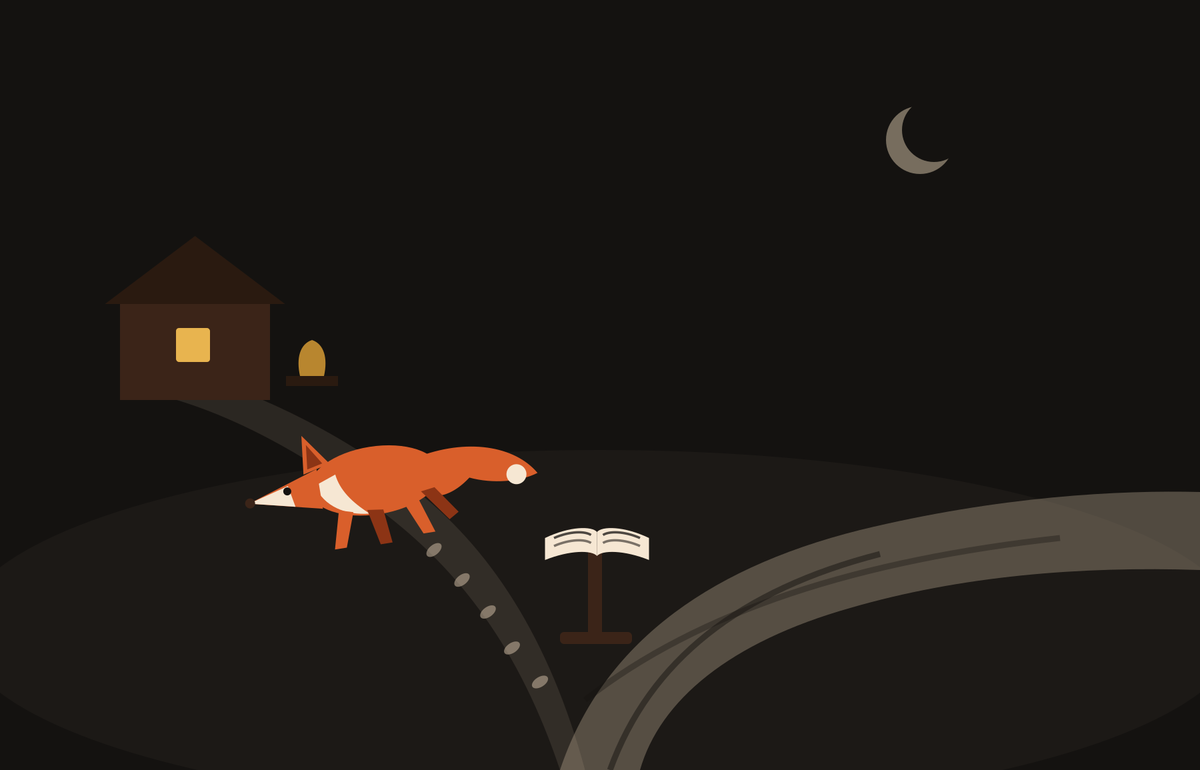
The Ledger and the Road
A FABLE ABOUT BEING FOUND
The town at the fork kept a ledger, and the ledger was famous for missing nothing. Every stall on every lane was written in it the week it opened: the potter’s shed, the bookbinder’s corner, the fox’s small table of stitched notebooks on the north lane. A clerk came, measured the doorway, wrote the name in a careful hand, and left. The fox watched her own name dry on the page and thought, reasonably, that the rest would follow.
The rest did not follow.
Visitors came to the town by the hundred, and the ledger sat open on its stand at the fork for anyone to read. But visitors do not read ledgers. They follow the road, and the road at the fork bent south, past the fountain, past the pie stand, past the six stalls that had always been there. The north lane was in the book and not in anyone’s morning.
The fox did what shopkeepers do. She swept the lane. She repainted the sign. She asked the clerk whether her entry had perhaps smudged, and the clerk checked and said, kindly, that the entry was perfect. “You are discovered,” the clerk said. “The town knows you exist.”
“Knowing I exist,” said the fox, “seems to be a thing the town does with its eyes closed.”
She stopped petitioning the ledger after that. Instead she watched the south road to see what it was made of. It was made of habits: the baker sent people to the fountain, the fountain crowd drifted to the pie stand, and every stall on the way pointed to the next one. Nobody on the south road was better than she was. They were only connected.
So the fox went to the potter, whose shed sat two lanes over, listed and lonely as her own. “Send your buyers to me for the notebooks their sketches deserve,” she said, “and I will send mine to you for the cups their ink deserves.” The potter turned this over, looking for the trick in it, and found only the shape of the south road, borrowed.
It was a small current at first, a trickle of people arriving with clay dust on their sleeves. But a visitor who is sent somewhere tells the next visitor, and paths wear in the direction people walk them. By the time the clerk came for the yearly measuring, she had to wait behind three customers, and she noted, in her careful hand, that the north lane had somehow moved closer to the fork.
It had not moved. It had been walked.
A ledger records that you exist; only a road admits it. If the road will not come to you, lay one to a neighbor, and walk it in both directions.