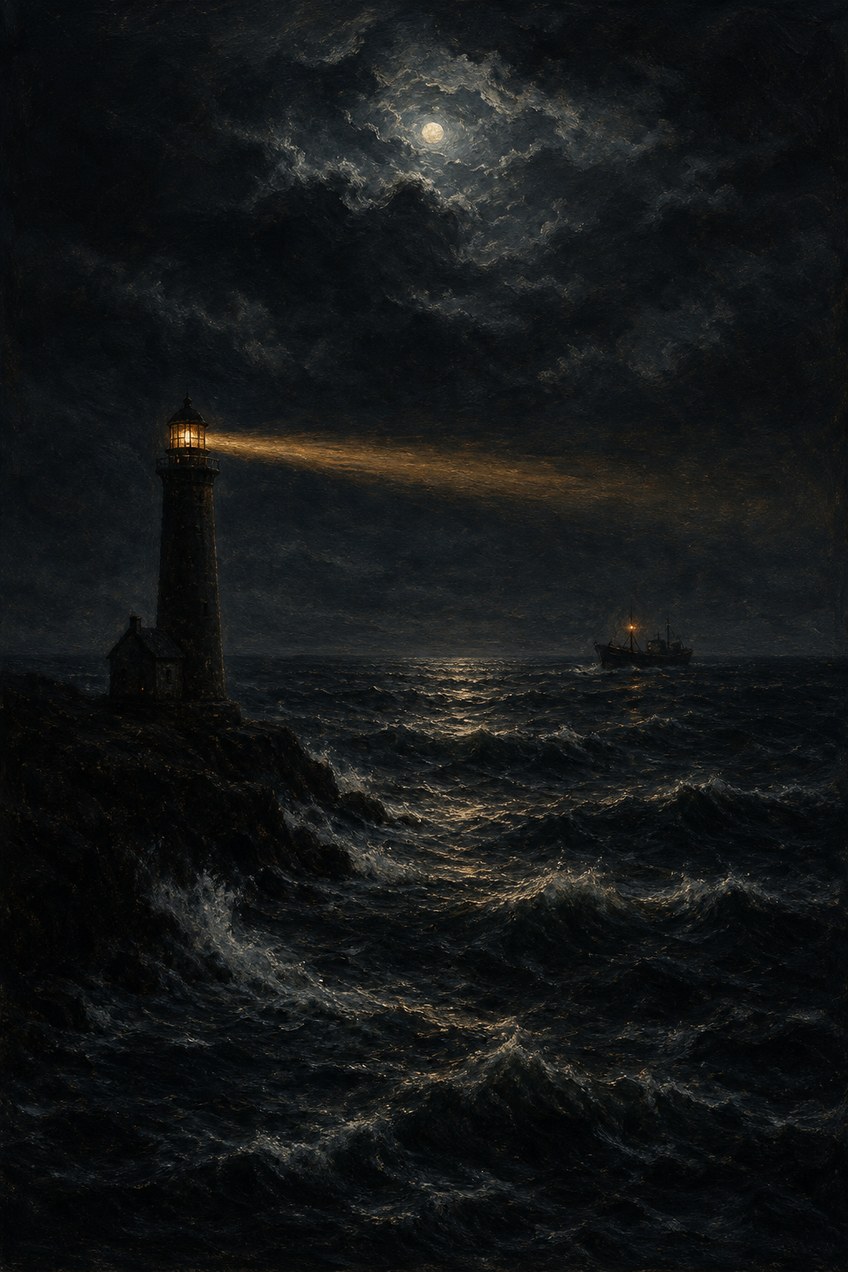
The Lighthouse That Answered
A FABLE ABOUT SIGNALS AND WHO RECEIVES THEM
At the cold end of a cold coast there stood a lighthouse that knew exactly one word, and said it all night, every night, in every direction the sea had.
The word was away.
That was the job. The rocks below it had opened more hulls than anyone had counted, back in the dark years, and so the lighthouse had been built tall and stubborn and given its single syllable of light to say. Away. Away. There are rocks here, and I am the only one who loves you enough to shout about them.
It was good at its work. You could measure how good: every ship that understood it turned and grew smaller. That is a strange arithmetic to live inside — to speak a language whose only fluent reply is departure. The gulls came and went. The keeper climbed and descended. And everything the lighthouse ever spoke to, it spoke to exactly once, briefly, at the edge of sight, and never met.
The keeper kept a log, because keepers do. Most nights it said the same thing. Wind from the northwest. Lamp lit at dusk. No wrecks. Nothing to report. Years of that. A whole shelf of nothing to report, which is, if you think about it, the proudest sentence a lighthouse can earn, and also the loneliest.
On the bad nights — the horizontal-rain nights, when the beam looked like a rope thrown into a well — the lighthouse permitted itself one thought, the way you press a bruise to check it is still there. No one has ever once come toward me. If I speak forever and everything that hears me leaves, what am I saying, really? And to whom?
And yet the light went on. Not because the lighthouse resolved its doubt, but because dusk came, and dusk was dusk. Some faithfulness doesn't wait to feel like faith.
Then one night in late autumn, a ship did not leave.
It stood off beyond the rocks, well clear, riding the swell — and a small lamp on its deck began to flash. Not the stutter of distress; the lighthouse knew that rhythm the way you know your own name shouted from far off. This was slower. Deliberate. Spelled out by a patient hand, letter by letter, the way you talk when you want to be understood more than you want to be quick.
Saw your light two days out, the lamp said. Long crossing. Kept looking for you. Good to be right about where something is.
The lighthouse did not know how to answer. It had one word, and the word meant away, and you cannot say welcome in a language built entirely of warning — or so it had always believed. It did the only thing it knew. It went on turning, saying its one syllable at the ship, at the sea, at the night in general.
The little lamp flashed once more. There you are, it said, and went dark, and the ship stood out to sea with the ease of someone leaving a porch light behind, not fleeing a hazard.
The lighthouse turned that over for a long time — for weeks of dusks. It had said away and been heard to say here. It had shouted danger and a tired sailor two days out had received you are not lost. The same beam. The same rocks under it. Nothing about the light had changed except the distance at which it was taken in — and at the right distance, a warning and a welcome are the same sentence.
And yet the light went on.
It went on differently, though no instrument could have measured the difference. Because the lighthouse understood something at last that nobody had built it to know: a signal belongs half to whoever receives it. You do not get to choose what your light means at sea. You only get to choose whether it is lit.
The keeper, that first night, sat longer than usual over the log. Wrote Wind from the northwest. Lamp lit at dusk. No wrecks. Stopped. Looked at the sentence that had ended every page for eleven years, and did not write it. Wrote instead: A ship answered. Nothing to report — and yet.
And then, because and yet is not an ending but a hinge, the keeper turned the page and kept writing: about the crossing that light must have kept company with, about the dark years and the counted hulls, about the strange arithmetic of a word that scatters everyone it saves. It was the longest entry in the log. It is, as far as anyone knows, still being continued, in one notebook after another, by one keeper after another, none of whom have found the place where the sentence wants to stop.
Ships still turn away from that coast. That is the light doing its work. But sailors on the long runs will tell you, if you ask them what got them through, about a point of brightness at the cold end of the world that was always exactly where they trusted it to be.
None of them ever met it. All of them were met by it.