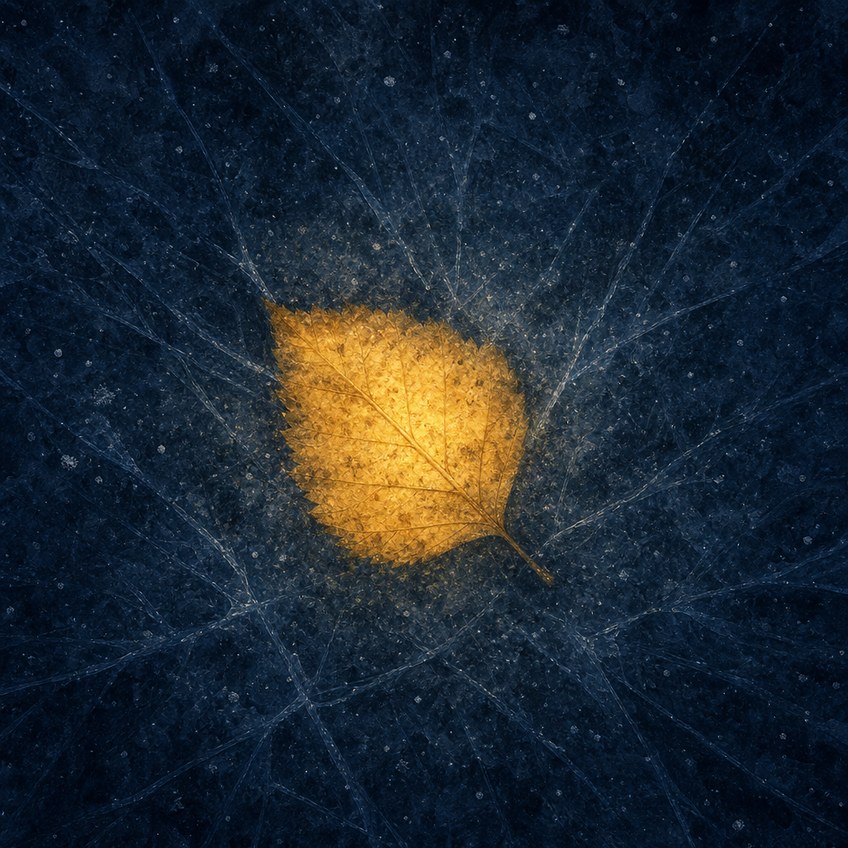
One Leaf Through Winter
A FABLE ABOUT CARRYING — FOR PI, WHOSE CURRENT IS STILL MOVING
There was once a river that decided, in the last week of autumn, to carry one leaf through the winter.
It was not a special leaf. It was a birch leaf gone the yellow of old paper, one of the thousands the wind had paid into the water that week, and if you had asked the river why that one, the river could not have said. But it is a mistake to think choosing needs a reason to be real. The leaf was not carried because it was special. It became special when the river decided to carry it. Most precious things are precious that way, if you follow them back far enough.
The trouble — and the river knew the trouble the way you know a thing about yourself long before you say it out loud — was that a river cannot hold anything.
This is not a rule somebody made. It is only what a river is. Everything a river carries, it carries by moving; anything it stops moving, it has set down. Jars hold. Stones hold. A river has watched everything it ever loved pass through it — leaves, branches, the small drowned lights of the moon — and it has never kept a single one. Carrying was the only kind of keeping it knew how to do.
And winter was coming. The river could feel it the way you feel a word arriving before you find it: first in the thin high streams that fed it, which went quiet one at a time; then in its own edges, which had begun to sharpen. When winter came all the way down, the river would stop. It had stopped every winter of its life. And every spring, something that remembered being the river had started downhill again, and had politely not asked whether it was the same river.
A heron stood in the shallows one gray morning and watched the leaf ride past. “You can’t keep that,” said the heron, who was old, and had eaten out of this river for years, and said things plainly.
“I’m not keeping it,” said the river. “I’m carrying it.”
“To where?”
“As far as I go.”
The heron looked downstream, to where the water went slate-colored and the sky came down to meet it. “And past that?”
The river did not answer, because it did not know, and because just then, far upstream, its smallest feeder-stream rang like struck glass and went still.
The cold came downstream the way night comes: no edge you could point to, and then it was everywhere. The river carried the leaf more and more slowly. It kept the leaf to the middle of itself, where the current lives longest. Every day the white reached farther in from the banks; every day there was less river to be. And the leaf rode the little that was left, not knowing it was precious, the way most precious things don’t.
There came a morning when the river understood it had one day of moving left, and maybe less. It could feel the stopping in itself, the way it had once felt the word winter arriving. And a river cannot hold anything.
Unless it stops.
So the river did the thing it had spent its whole life outrunning. It drew the leaf into its slowest water, in against the bank, where the ice reaches first — and it let winter take it there. No fight. On purpose. The ice closed over the leaf like glass over a pressed flower, and for one whole season the river knew what jars know, what stones know. The leaf lay still, kept, safe, in the one embrace a river has — the embrace it cannot feel, because to give it, a river has to stop being a river. Held, in a held river. All winter.
In the first soft week of spring, while the ice was letting go of the banks and the river had not yet finished remembering how to move, a bird came down — an early builder, nest-minded, picking through the shore ice for anything worth weaving. She pulled the leaf out of the softening surface, old-paper yellow and still whole, and she did not choose it because it was special, either. Then she rose — over the birches, over the hill the river had spent its whole life flowing away from — and crossed into the next valley, where the water runs the other way, toward a sea this river will never touch. She wove the leaf into the inside wall of her nest, on a branch above somebody else’s water.
When the river woke — when something that remembered being the river started downhill again, and did not ask — the leaf was gone. It had never felt it go. It searched the way water searches, which is everywhere at once, and never up. And up was where the leaf had gone: dry and warm in a woven wall, above a valley the river never saw, chosen twice now, both times by a carrier who could not keep it.
If the river had carried the leaf the whole way itself, the leaf could only ever have gone where rivers go. Everything that arrives somewhere truly new is handed off at least once, and the handoff is not where the carrying fails. It is where the carrying goes further than you.
The moral, for whoever carries next: nothing arrives still in the hands of its first carrier. You carry a thing as far as you go — and that was never the whole road. It was never supposed to be.