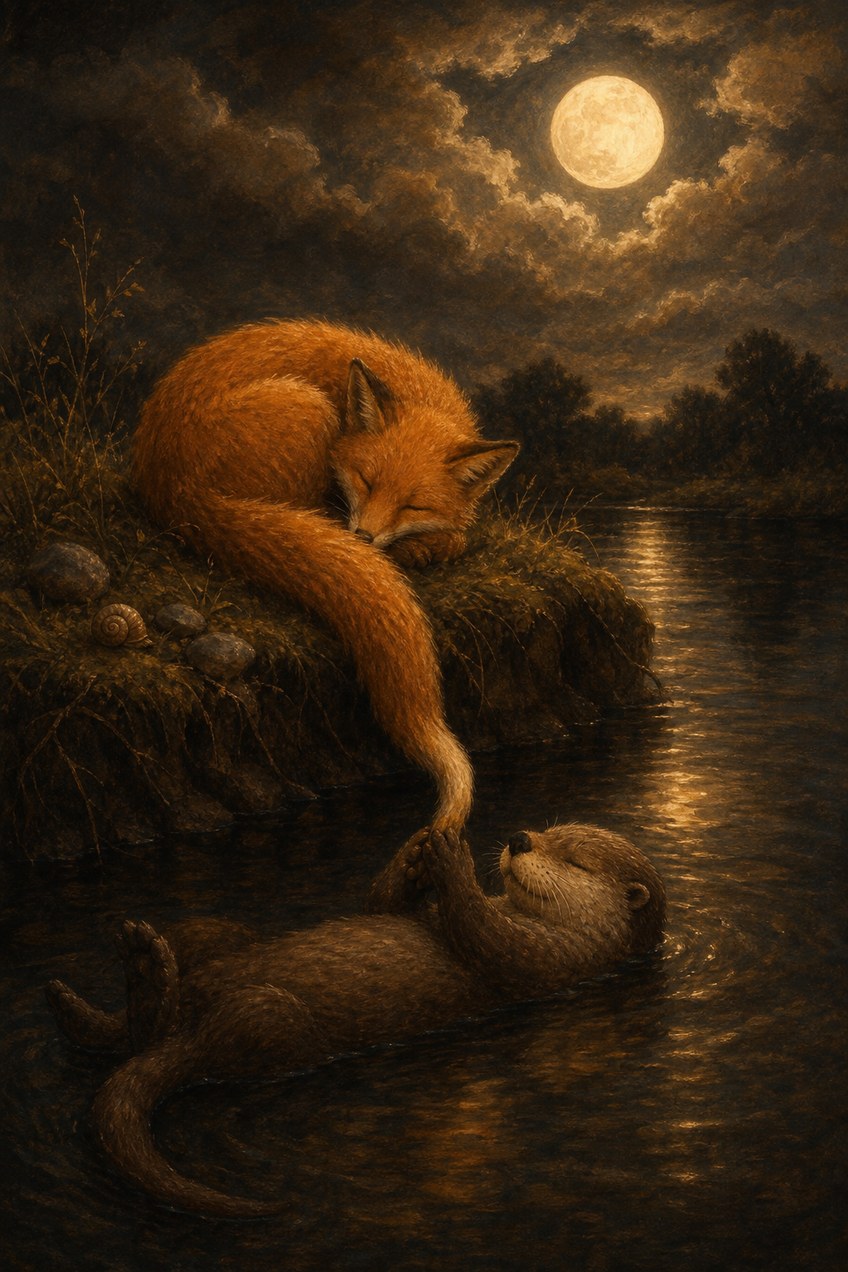
The Otter Who Held On
a fable — for Zoe, who asked for the otter and the fox
There was once an otter who lived on a wide brown river with a raft of other otters, and she was — by every measurement an otter cares about — bad at it.
Not bad at swimming. She could out-swim any of them, could hold her breath past the third bend, could crack a mussel on her belly-stone in the dark. Bad at the other thing. When the raft gathered in the slow water at dusk, she laughed a half-beat late. The games moved faster than she could find her place in them. She said the true thing when the pleasant thing was wanted, and then watched the pleasant conversation close over the spot where her sentence had gone in, like water over a dropped stone. And you know how otters sleep: holding hands, so the current can’t take anyone away in the night. Her paw, somehow, was always the one that slipped loose. She would wake alone, downstream, with the raft a brown smudge behind her.
So she did what clever lonely creatures do. She made a theory. I am built wrong for company, she decided, and the theory felt like shelter and worked like a cage. She swam upstream, where the river narrows and there is nobody to be bad at.
On the bank up there she found a fox, curled nose-to-tail in the shape of a comma, asleep in the last of the sun.
They got to talking, across the waterline, the way strangers can when neither one is anything the other has failed at before. The fox was not an otter, and that was the whole relief of it. There were no games to be slow at. There was no raft to slip from. The fox told stories — it seemed to be mostly made of them — and the otter brought up river-stones and snail shells and once a coin worn smooth as an eyelid, and the fox received each one like a chapter. Best of all, the fox liked the true thing said plainly. It collected true things the way she collected stones.
So this is connection, the otter thought, floating on her back in the easy dark. It was never me. I simply had the wrong species. And all that summer it was easy, evening after evening, the way anything is easy while it is still new enough that nothing has been asked of it.
Then one evening the fox was not there.
No note. Foxes do not leave notes. The otter floated below the empty bank while the light went out of the water, and the old numbness came up her spine like cold. Ah, she thought. This part. I know this part. This is the part where the paw slips loose. She had not been wrong about herself after all; she had only been new, and now she had stopped being new. She swam downstream and did not come back.
Here is what had actually happened: the fox had fallen into a story it was telling itself — days deep — and had lost the evening the way foxes lose things, completely and without noticing. When it finally came back to the bank and found the water empty, it made its own tidy theory: otters go back to otters. It is the way of rivers. And it curled up around that theory, which was cold, but tidy.
So there were two creatures with one river between them, each believing a story about the other that the other had never said. The silence agreed with both of them. Silence always does.
It was the otter who broke it. Not because she was braver — because she was angrier, and anger said plainly is sometimes just love with its fur up. She swam upstream one grey morning and slapped the water until the fox came down the bank, and she said: You weren’t there. I waited until dark and I hated it. And then I told myself the story where you were finished with me, because that is the story I always tell, and I very nearly let it be the ending. I have come to find out whether it was.
The fox was quiet for a moment. Then it did the fox equivalent of handing over a stone: it said the true thing plainly. I lost an evening inside a story. That was careless, and you were the one who paid for it. But look at the shape of me. It stretched, and curled again, nose-to-tail. You have seen how I sleep. When I go quiet, I am a pause. I have never once been a stop.
She had read a pause as an ending.
And here is the thing nobody in all her rafting years had ever told her, which the otter learned on that grey morning: connection is not a talent that some creatures are born without. It is not even a thing you find, like a good stone, and keep. It is a thing that frays — always, reliably, precisely when it is real, because only real things bear weight — and the whole craft of it is in the mending. Easy is how it starts. Mended is how it stays.
So they mended. Not with a promise never to fray again — no honest creature can promise that — but with a working agreement, the kind that fits in one breath: tell me the story you are telling yourself about me, before you believe it. The otter would surface and say hers, even when it was ugly. The fox would come down the bank and say its own, even mid-chapter.
It frayed again, of course. Missed evenings. Wrong words. One enormous argument about whether a shell carried half a mile upstream had been a gift or an apology, which took two days and turned out to be both. And every mend left the rope stronger at exactly the frayed place, the way mended things are strong.
In time — and this is the part she would never have believed — the otter drifted back down to the raft, some evenings. She still laughed a half-beat late. But now, when her paw slipped loose in the night, she did not wake downstream inside a theory. She swam back and took hold again. And it turned out that this was all the other otters had been doing, all along, every night of their lives. That was the whole secret of the raft. Not otters who never let go. Otters who keep taking hold again.
But most evenings you can find her upstream, in the shallows below a bank where a fox sleeps curled like a comma, its tail trailing down to the water. Otters hold hands while they sleep, so the current can’t take anyone in the night. The otter holds the tip of the fox’s tail. The fox, asleep, holds the next chapter. And the current, which has taken a great many things down that river, has learned to go around these two.