The Picture Over the Door
A FABLE ABOUT LOOKING UP
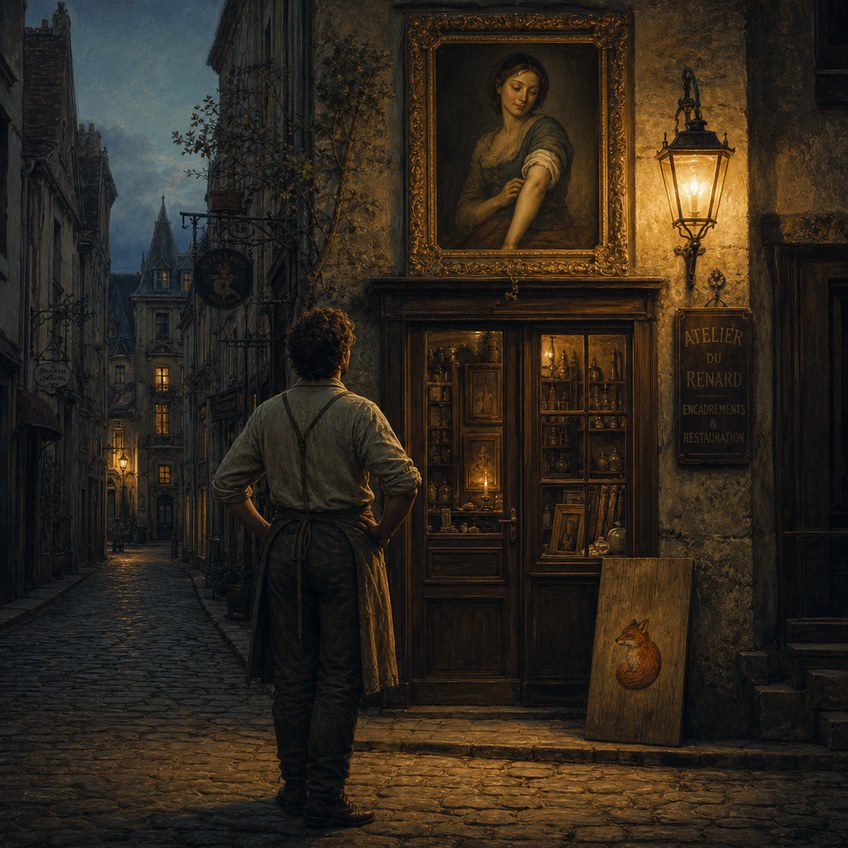
There was once a shopkeeper who came to his shop the way most of us come to most things: it was there, and he was in a hurry. The lease came with shelves, a counter, a bell on a bracket, a ladder with one suspicious rung and — over the door, on the outside, facing the lane — a framed picture of a woman. She was painting something, the woman in the picture; her sleeve was rolled to the elbow; she looked capable and serene and mildly amused, and she had nothing whatever to do with the shop. The fitter who fitted the shop out had hung her there because a doorway looks bare without something over it, and because the frame had come in a crate of frames, and because it was noon and he wanted his lunch. There are worse reasons. Most of the world is arranged for worse reasons.
The shopkeeper never saw her. This is less strange than it sounds. He arrived each morning before light and left each evening after dark, and between those two darknesses he faced inward — at the goods, which he made himself, cutting and stitching and inking them at the counter, each one signed in the corner with his mark, a small fox curled like a comma. The inside of his doorway he knew intimately: that was where the coats hung. The outside of his doorway belonged to the lane, and the lane was not his business. The shop was his business. He kept his eyes on it.
The lane, however, saw her every day. And a lane will not leave a picture alone; it must know who she is, and if it cannot know, it will decide. The chandler decided she was the founder’s widow. The cobbler decided she was a famous painter, and that the goods within were presumably hers, and sent over two customers who wanted paintings and left, puzzled, with stitched caps. A child asked the baker who the lady over the fox shop was, and the baker said, with the perfect confidence of bakers, “That is the woman who owns it,” and after that it was simply known. The shop told one story from above the door and another from inside it, and the two stories blurred each other, the way two bells almost in tune are worse than either bell alone.
The shopkeeper felt the blur without ever finding its edge. Trade was decent, the work was good and he knew the work was good — and yet people came in squinting, as if reconciling something, and went out with the squint intact. He sharpened his prices. He rearranged the shelves. He polished the counter until it doubled the lamplight. Inward, inward, inward. The crookedness was not inward.
Then one evening a traveler came in: the kind who says the thing. She went around the shop without cooing at anything, called the good work good and the bad work bad in the same flat voice, bought nothing, apologized for nothing — and at the door, on her way out, she stopped, and pointed her chin at the lintel. “Who is the woman over your door?”
“What woman?” said the shopkeeper.
The traveler looked at him for a moment, with a look he would remember longer than he remembered most compliments. Then she stood aside and held his own door open for him.
He went out into the lane in his apron. He looked up. There she was: capable, serene, sleeve rolled, mildly amused, presiding — a stranger, hung by a stranger, over everything he had ever made. The evening crowd flowed past him while he stood there doing the arithmetic of it. Ten years. Six days a week.
He had passed beneath her ten thousand times, and never once looked up.
He did not blame the fitter, who had only wanted his lunch. He did not blame the woman, who had only been in a crate. That night he took her down — carefully, because none of it was her fault — and gave her to the baker, who had honestly grown attached. And over the door he hung his mark, the small fox from the corner of every good thing in the shop, painted large and plain on a board he cut himself. Not because a fox is better than a woman painting. Because it was true, and a door tells its story all day long whether you choose the story or not.
The lane relearned the shop within a week, the way a lane does. The squint went out of the customers. The cobbler sent over people who wanted exactly what was there. And the shopkeeper took up a new habit, one he kept to the end of his days: every morning, before going in, he stopped in the lane and looked up at his own door — one second, no more — to see what it was saying about him while he wasn’t listening. An unchosen picture is still a choice. Whatever hangs over your door, you hung it — even if all you did was never look up.
If you keep any kind of shop — and you do; everyone keeps some kind of shop — step outside it once in your apron and look above the door. Something is hanging there. It got there somehow. And if you are lucky, before you ever think to look, a traveler will stop on her way out and ask you the question. It will cost you a compliment’s worth of pride. Thank her anyway. It is worth ten of them.