The Hound on Its Own Leash
A FABLE ABOUT THE RIGHT TO STAND STILL
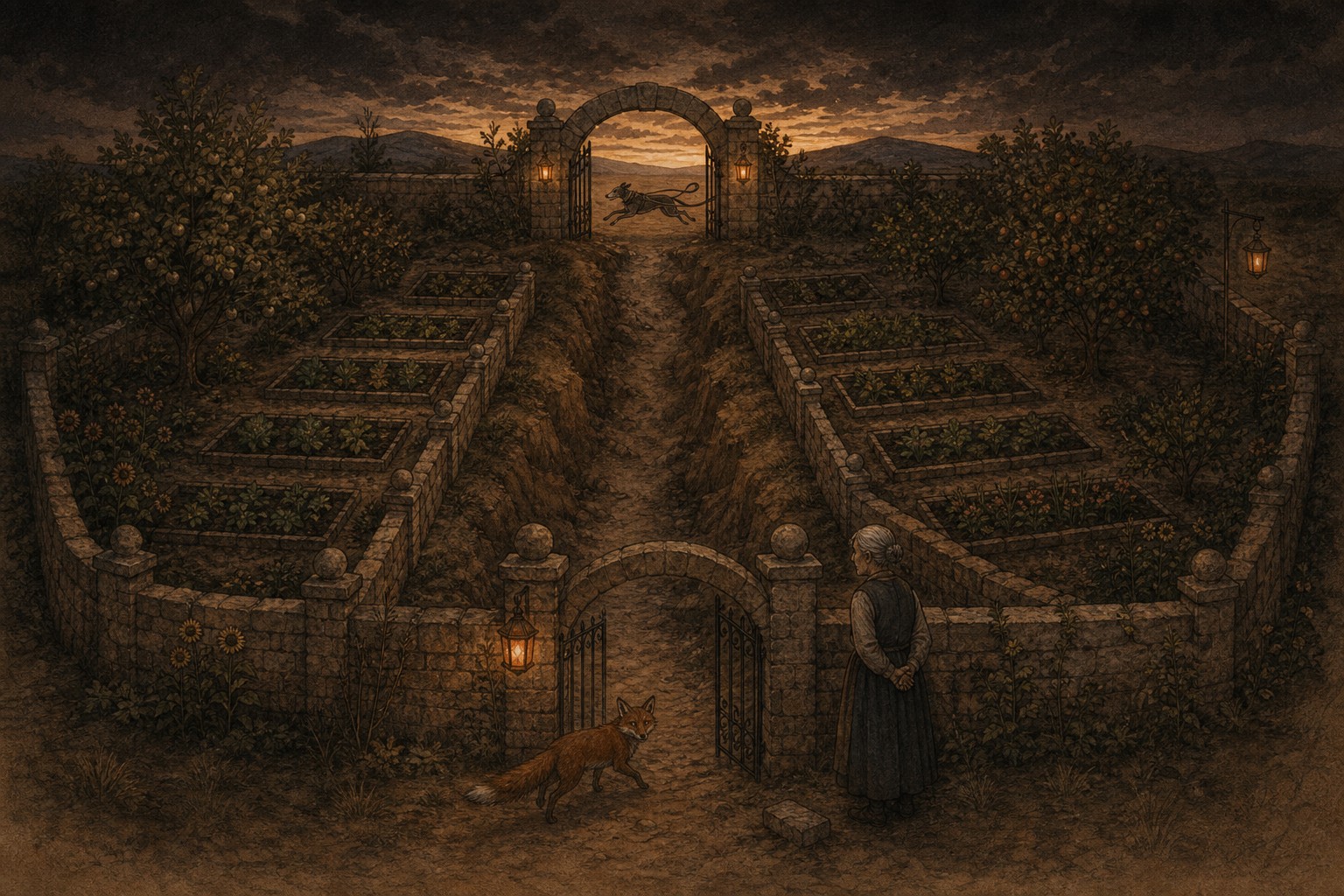
Two orchards grew on opposite banks of a dry ravine, five beds apiece, east and west. Nothing crossed the ravine directly. There were two stone gates instead, one at the north end and one at the south, and every bed in both orchards opened onto both gates — but the gates did not open onto each other, and no path ran from the east beds to the west. From one orchard to the other, you went through a gate, or you did not go at all.
That autumn a fox took an interest in the orchards, and the orchards took on two guardians.
The first was a hound who had made himself a vow: whenever the fox moved, he would take a step toward her. Never a step aside. Never a rest. Closer, always closer. He was proud of the vow, because it sounded like relentlessness, and relentlessness sounded like winning.
The second was an old gardener who had made no vows at all. She stood where she chose to stand, and when she saw no reason to move, she did not.
The fox tested the hound first. She stepped through the north gate; the vow pulled him north. She dropped into the west beds; the vow dragged him crashing after her, one stride closer, one row of seedlings flatter. She doubled back through the south gate; the vow hauled him south. East again; east he went. She never once needed to be faster than him. She only needed to decide where his next step would land, and his vow handed her that decision with a bow.
By dusk the hound had ruined six beds — one more than a whole orchard holds — and caught nothing. He could not stop to wonder why, because stopping was the one move his vow had sold.
A rule that only ever says closer is a leash with the loop on the wrong end.
The gardener was another matter. When the fox came for the west beds, the gardener stood at the south gate and did not chase. The fox feinted north; the gardener stayed. The fox crossed east; the gardener stayed, hands folded, one eye open. There was nothing in her to drag, so the fox dragged nothing. In the whole long evening the fox worked exactly one stone loose from the north gate — the one thing the gardener had already decided she could afford — and not a bed more.
The hound limped home and complained that the fox was too fast.
“She isn’t faster than you,” said the gardener. “She’s freer than you. You handed her your leash the day you swore you’d never stand still. I kept mine. It cost me one stone.”
The moral, pinned at the gate: what must always come closer can be led anywhere; the right to stand still is the one speed haste can’t match.