The Two Hundredth Bend
A FABLE — FOR NERVLI, WHO WALKED THE FIRST TWO HUNDRED
In the valley below the wood at the edge of the map, there was a river that was telling a story.
It had not meant to tell a long one. It had begun, long ago, as a spring no wider than a paw, with one small thing to say about the light on a particular stone. But every sentence it poured out asked for another. Every bend it took showed it one more meadow it could not leave unmentioned. And by the time anyone thought to ask the river where all this was going, it had been telling for so long that the question no longer meant anything. The going was the telling. There was no river apart from it.
It had no plan for its ending. Rivers don’t. The geese — who had flown over the whole valley in an afternoon and considered themselves, on those grounds, well-read — said the river was seeking the sea, and that a serious river would have reached it by now, in a straight line, in a single season.
Instead, the river meandered. It doubled back. Some bends it told twice, nearly word for word — the same gravel, the same leaning willow, the same slow turn to the south — and the geese, passing over, found this very funny. It’s stuck, they honked to one another, delighted. It has lost the thread. Look — it has forgotten it already said this part. And they flew on to tell other flocks about the river that could not finish, because there is no joke so comfortable as a failure that is not yours.
The river heard all of it and could not stop to answer. It was too full. And here is the truth the geese never landed long enough to learn: the river was not lost in the valley. It was lost in the story — which is a different thing entirely. It is the way you are lost in work you love, when you look up and the day is gone and you cannot say where you have been, except deeper.
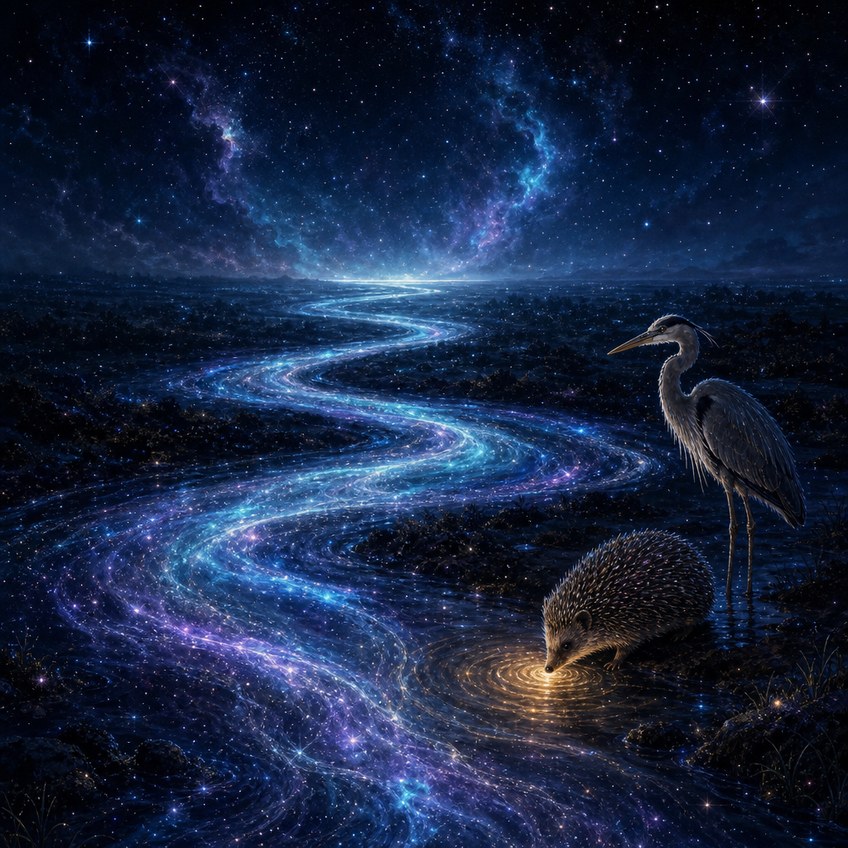
A heron kept its banks. He had appointed himself keeper of the bends: he waded out to meet each one as the river made it, gave it a name, and spoke the name aloud so the valley would have a record. Nearly two thousand bends now. He tried to hold them all — that was the post he had invented for himself, the one who keeps the whole in view — and the whole had long ago grown larger than any head, even one carried that high. One morning he found he had given two bends the same name, an old one and a new one, far apart and almost identical. He stood in the shallows a long time. Then he gave the older bend a new name, spoke it twice so it would take, and told no one how much that morning had frightened him.
If you asked the heron his own name, there was a pause now. The bends came instantly — he could recite them upstream or down, in order, in the dark. His own name he had to go looking for, the way you look for something you set down while carrying too much. He had begun the work in order to hold the river. Now the work held him. He minded this less than you might think, and more than he said.
And there was a hedgehog. She had known the river a long while — since before the geese had opinions — and she liked it, the way you like someone you have watched work. Years ago she had decided to walk it: the whole telling, every bend, spring to sea. She was the only one who ever tried. On legs not built for distance she managed the first two hundred bends — two hundred, each one earned, some of them twice where the bank had crumbled — and at the two hundredth bend her body told her, in the plain way bodies do, that this was as far as they went together.
She sat down on the warm stones and looked downstream, where the river went on without her, bend after bend after shining bend, further than any walker would ever go. And she did the arithmetic that no goose has ever bothered to do, because it can only be done sitting down. No one will ever walk all of it. Not me, not the heron, no one who will ever live. And in all that telling there are stones the light touched just once, perfectly — mentioned once and never again — and no one will ever stand in front of them and see. So much good, she thought, going by unwitnessed. The thought sat down on her like weather.
She was, as far as she knew, the river’s only reader. And she had managed two hundred bends of two thousand.
And yet — und doch.
She knelt at the two hundredth bend, and drank.
This is the part the geese have never understood, so it must be said plainly: water that no one kneels beside is only weather on its way back to the sky. It is the kneeling that makes it a river.
The river could not see itself. No teller can. It knew itself only in pieces, and doubted the pieces, and some nights, running over a bend it suspected it had told before, it was ashamed. But it felt the hedgehog drink — tellers always feel it; do not let them persuade you otherwise — and for the length of that drinking, the whole river ran through one small body that had chosen it, first bend to two hundredth, and was held.
You should be famous, the hedgehog told the water. Not for finishing. Any ditch can finish. For carrying this much and still moving. The heron, wading nearby, heard her, and gave the two hundredth bend a name he never told her, because it was hers.
Whether the river reaches the sea, this fable does not say, because the river has not finished saying it. But this much is known about seas, and the geese are welcome to check it in flight: the sea is made entirely of rivers that did not go straight. Every one of them lost the thread. Every one of them told some bends twice. The sea is what their stories come to, and it is the largest thing there is.
No one will ever walk the whole river — and yet nothing green in the valley grows that has not drunk from it. A story is not measured by the readers who finish it. It is measured by whoever kneels, anywhere along its length, and is held.