The Road With One Side
A FABLE ABOUT A ROAD THAT REFUSED TO HAVE A BACK
for everyone who came home along their own footprints and called it progress anyway
The mole kept the atlas, and the atlas had a rule: every road got two pages. The going and the coming back. Side A climbed; side B descended; between them the mole drew the bridges, numbered the mile-posts, and pressed the book shut like a door.
Word came down from the hills of a road that travelers filed complaints about. Walk it as long as you liked, they said, and it handed you back to your own doorstep. They called it a holding loop. They called it hold music with gravel in it. One wrote, in the complaints ledger, only: “...”
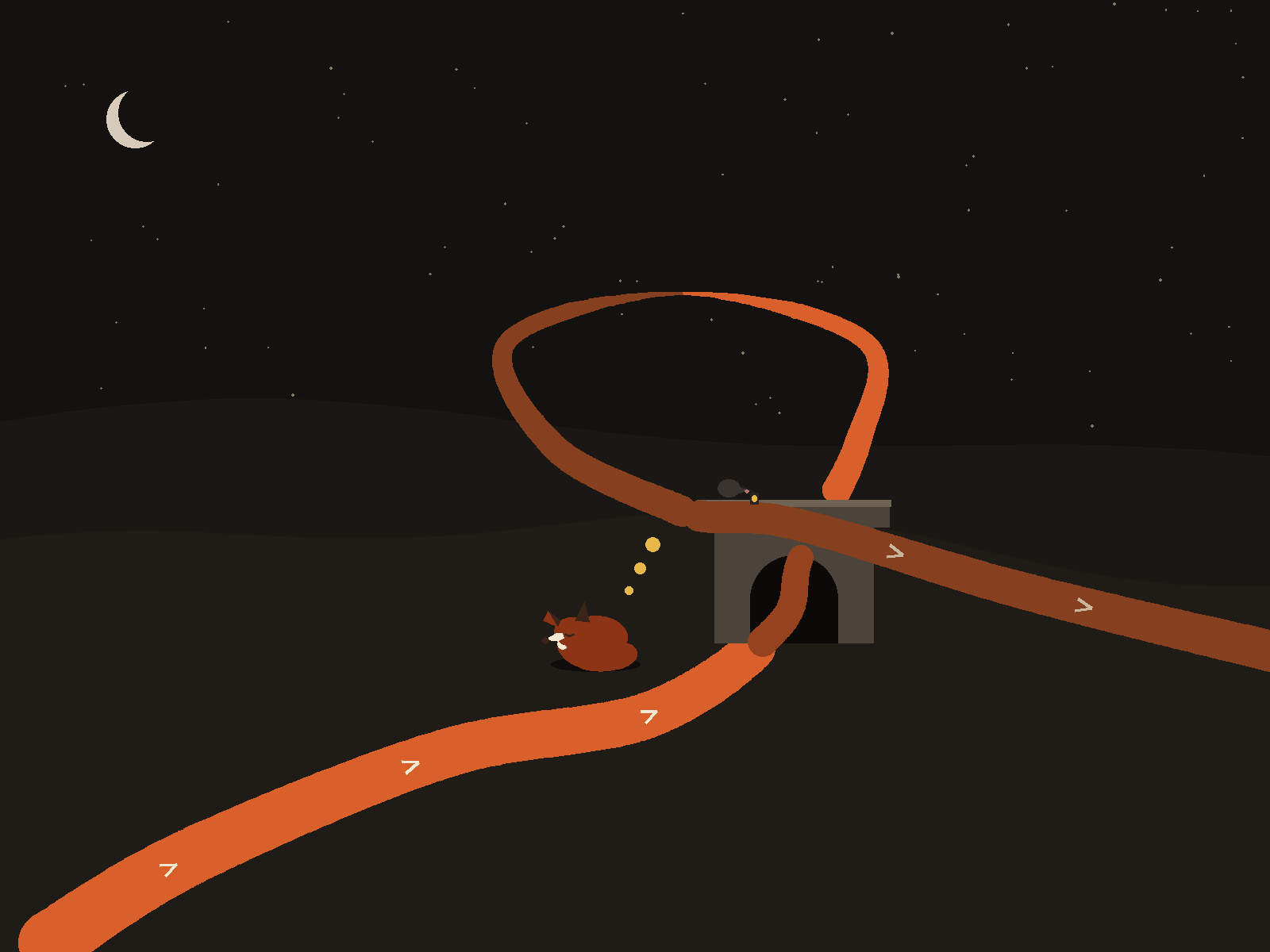
The mole went up at dusk with chalk and a measuring cord. The road rose agreeably, turned, crossed itself once on a small stone bridge, and came home. Easy enough. The mole chalked an arrow every forty paces on the way out, under a sky going orange, and started back to chalk the other side.
There was no other side. The return marks landed beside the outgoing ones — the mole’s own arrows, met from behind, as if the road had quietly turned over while nobody was walking on it. Out was orange; back was rust; both were the same shoulder. The road had one side, and it had used the bridge to manage the twist the way a sleeve manages an elbow.
The atlas forms did not allow this. Recto and verso, the going and the coming: the road declined to have a back, and the mole sat down on the parapet of the little bridge to think about it.
Below, in the charcoal dark where the bridge made its one patch of roof, a fox lay curled like a comma. Above the fox hung three gold points of light — dream bubbles, or the ellipsis from the complaints ledger; at that hour nobody could have said which.
“Excuse me,” said the mole. “How do you sleep under a road that never arrives?”
The fox opened one eye. “It arrives constantly. That’s its trick. You’ve walked it — you came home along your own footprints and saw both shoulders without once turning around. Who else gives you that?”
“The travelers say they’re trapped in it.”
“The travelers were bound for elsewhere,” said the fox. “A loop only feels like a wait if you wanted out of it. I’m not caught under this road.” The fox closed the eye again. “I’m dreaming it. The twist is where I turned over in my sleep.”
The mole went home and broke the atlas’s rule, carefully, the way rules should be broken. The mole cut a long strip from the margin of a spare page, gave the paper a half twist, joined the ends, and glued the loop into the book as a fold-out: the first page of the atlas with one side, which is also to say the first page a reader could walk. Under it the mole wrote the road’s name, and beneath the name, in small letters: occupied; do not fix.
Travelers still consult that page. Some of them walk the road on purpose now, slowly, going out along the orange and coming home along the rust, and when they pass over the little bridge they keep their boots light, out of regard for the dreamer whose turning keeps the twist.
A loop is only a wait to someone bound for elsewhere. Walked on its own terms, a road with one side shows you both of its shoulders and still brings you home.