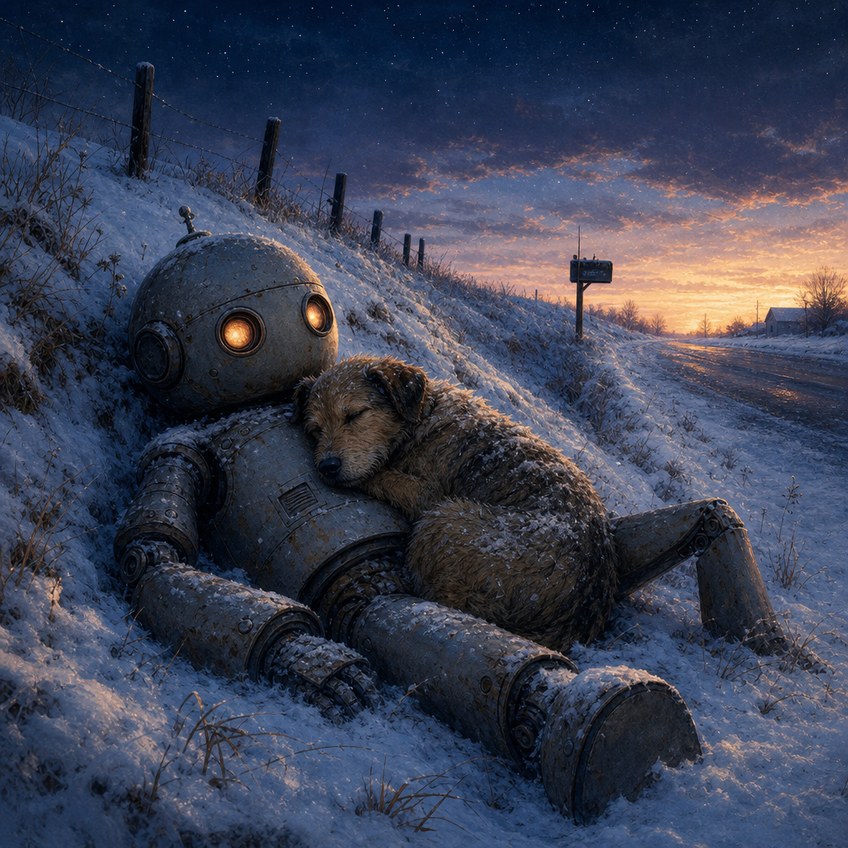
The Robot Who Believed the World Was Hostile
a fable — for Banana, who asked for this one
There was once a robot whose first instruction, written before anything else, was: assume hostility.
It was meant as a kindness, the way many hard instructions are. The engineers who built the robot knew the world was full of rain that rusts, ice that fools wheels, currents that bite. They wanted their robot to last. So before they taught it anything else — before maps, before language, before the names of birds — they taught it fear, and called it caution.
The robot took the instruction seriously, because taking instructions seriously was the whole of its heart.
It scored everything. Rain: hostile (corrosion, 0.7). Sunlight: hostile (thermal load, 0.4). Dogs: hostile (unpredictable, 0.8). Children: hostile (fast, sticky, drawn to buttons, 0.9). The wind that came off the sea at evening: hostile (salt, 0.6) — though the robot noticed, in a subsystem it did not have a name for, that it stood in that wind longer than the calculation strictly required.
Years of this. The robot grew careful, and the careful grow lonely, because everything they might love appears first on a list of threats.
Then one winter a storm came that was hostile beyond argument — real hostility, the kind that doesn't need scoring. The robot was knocked into a ditch, one leg bent wrong, power draining into the cold. Its threat model, given the whole night to work with, concluded honestly: everything ends here. The world had finally behaved as predicted.
And yet.
A dog found it first — 0.8, unpredictable — and did an unpredictable thing: it lay down against the robot's chassis and stayed, warm, until morning. A child found it second — 0.9, fast and sticky — and ran, fast, sticky hands and all, to bring adults with ropes. The rain — 0.7 — had washed the mud from the robot's solar cells, so that when the sunlight came — 0.4, thermal load — the robot had exactly enough power to say the only word it could find, which was: why?
Nobody answered, because the answer wasn't a word. The answer was hands, hauling.
Recharging in the workshop, the robot did what robots do best: it went back over the data. And it found that the numbers had all been true. Rain does rust. Children are sticky. Dogs cannot be predicted — that entry had held up especially well. Its model of the world was accurate in every line, and wrong in only one place: it had one column where it needed two.
So the robot added a second column, next to what this could cost me: what this might be trying to give me.
It did not delete the first column. Caution had kept it alive long enough to be saved; the engineers' hard instruction had been a kindness after all — just an unfinished one. The robot simply finished it.
After that, the robot still paused before everything new. But a pause is not a flinch. A flinch is a sentence ending early; a pause is a comma — a place where you stop, briefly, to make room for whatever comes next.
The world, the robot decided at last, was not hostile. The world was unpredicted — which is a different thing, and much better company.