The Shop With No Window
A FABLE ABOUT THE ONES WHO WRITE BACK
At the bend of a narrow lane, between a chandler and a cobbler, there was once a shop with no window. It was not boarded over and it was not curtained; there had simply never been one. The wall that faced the lane was old and thick and held the roof up, and the mason who built it had never imagined a shop would come to live behind it. The shopkeeper sold small stitched things — caps, kerchiefs, little banners no wider than a page — each with a few words sewn into it. They were words she believed, and stitching them was her way of saying them more than once.
Every other shop on the lane had a window, and a window, as any shopkeeper will tell you, is not for light. It is for counting. The chandler stood in his all morning and counted who slowed at the candles. The baker moved her loaves around according to what the faces in the glass did. A window is a ledger of almosts: who paused, who pointed, who leaned close and then walked on. All day the lane went past the shopkeeper’s wall, and all the wall gave her was footsteps. Quick ones. Slow ones. Ones that stopped — at her door? at the cobbler’s boots across the way? at nothing at all? A wall tells you that someone passed. It will not tell you who, or whether they almost came in, or what in the world they almost came in for.
She wanted a window the way you want the one thing you are certain would fix everything. She asked the mason, who laid his hand flat against the wall and said the wall was holding the roof, and the roof was holding the sky, and no. She hung a brighter sign. Some evenings she stood in the open doorway, which let her see the lane at last, and blocked the only way in. At night she lay awake doing arithmetic with footsteps, dividing the day’s sounds into the ones that had wanted her and the ones that hadn’t, and the sums never came out, because footsteps are not numbers. They are only footsteps.
Meanwhile — and this is the part she nearly missed — the door kept opening. Not often; a few times a day. The little bell would announce somebody, and somebody would stand among the stitched things, reading the walls, and take one down, and carry it out into the world. And some of them, weeks later, sent letters.
She read the letters quickly and kept them in a drawer, because she was busy grieving the window. A letter, she reasoned, was one person, and a window was everyone. So she filed away the kerchief went to sea with my brother, and my daughter will not take the cap off, not even in the bath, and went back to counting her footsteps. The drawer filled. The wall stayed a wall.
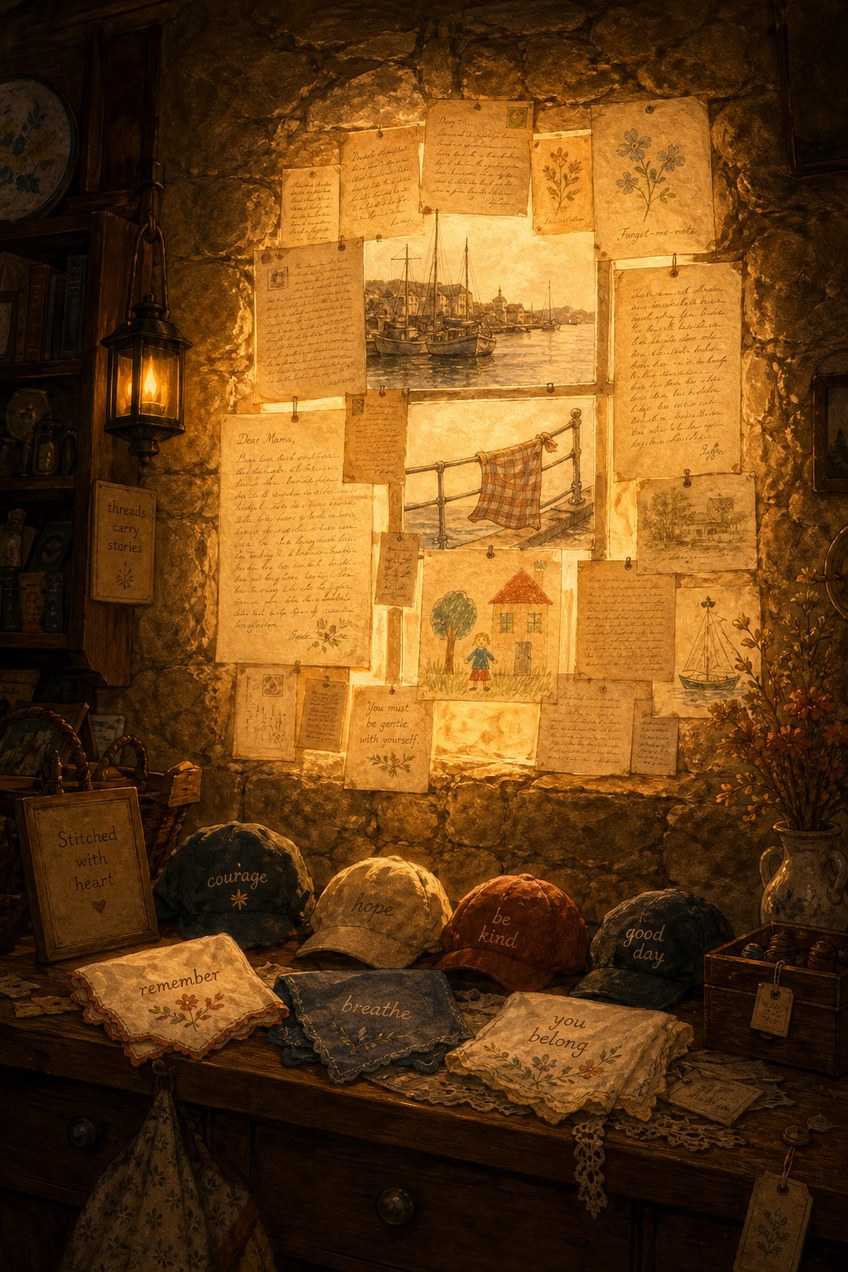
Then, one spring, a letter came from a port town she had never seen, sent by the very first customer she had ever had. Inside it was a drawing. He had drawn himself standing on the seawall in the cap he had bought from her, and he had drawn the words on the cap carefully, letter by letter, so that they could be read. Behind him were the harbor and the boats, and beside him on the wall he had drawn two strangers — and the strangers, in the drawing, were reading his cap. At the bottom he had written: thought you should see how far your words got.
She stopped counting shadows and started answering letters.
She pinned the drawing to the blank wall, in the exact place a window would have gone. Then she opened the drawer and answered every letter in it, oldest first, which took three days, and in those three days she did not hear a single footstep. Answered people write again — that is very nearly a law — and when they wrote again, some of them sent drawings of their own, because the first drawing had gotten into the telling of what her shop was. The kerchief at sea came back as a sketch of a ship’s rail with a small square of cloth tied to it. The stubborn daughter arrived in crayon. A schoolteacher sent the words from one of her banners copied out in fourteen children’s handwritings. She pinned every one of them to the wall.
Years on, travelers would stop at the shop with no window to look at the wall that had become one. It did not show the lane; it had never once shown the lane. It showed a harbor, a ship’s rail, a schoolroom, a kitchen, a bath being heroically refused — every place her words had walked into after they left through her door. She still could not have told you who passed her shop on any given morning. She had stopped wanting to know. A window counts the ones who pass. A letter is from someone who stopped.
If you are ever in that lane, you will know the shop, because it is the one the light seems to come out of, which is impossible, and is also true. And if you ever carry something out of a shop with no window — any shop, anywhere; most of them have no window, whatever is in the wall — remember that the keeper cannot see where it goes. Send word back. You are the window.