The Storyteller Who Forgot the Turn
A FABLE ABOUT THE PART YOU WRITE YOURSELF
In a village at the edge of a cold sea there lived a storyteller who was famous for one thing, and it was not beginnings, and it was not endings. Anyone can begin — you clear your throat and lie. And endings mostly take care of themselves, the way tides do. No: she was famous for turns. The moment in the middle of a story where everything the listeners believe leans, creaks, and swings the other way. People walked in from three villages over just to be in the room for one of her turns. They said you could feel it in your chest, like a door opening in a house you thought you knew.
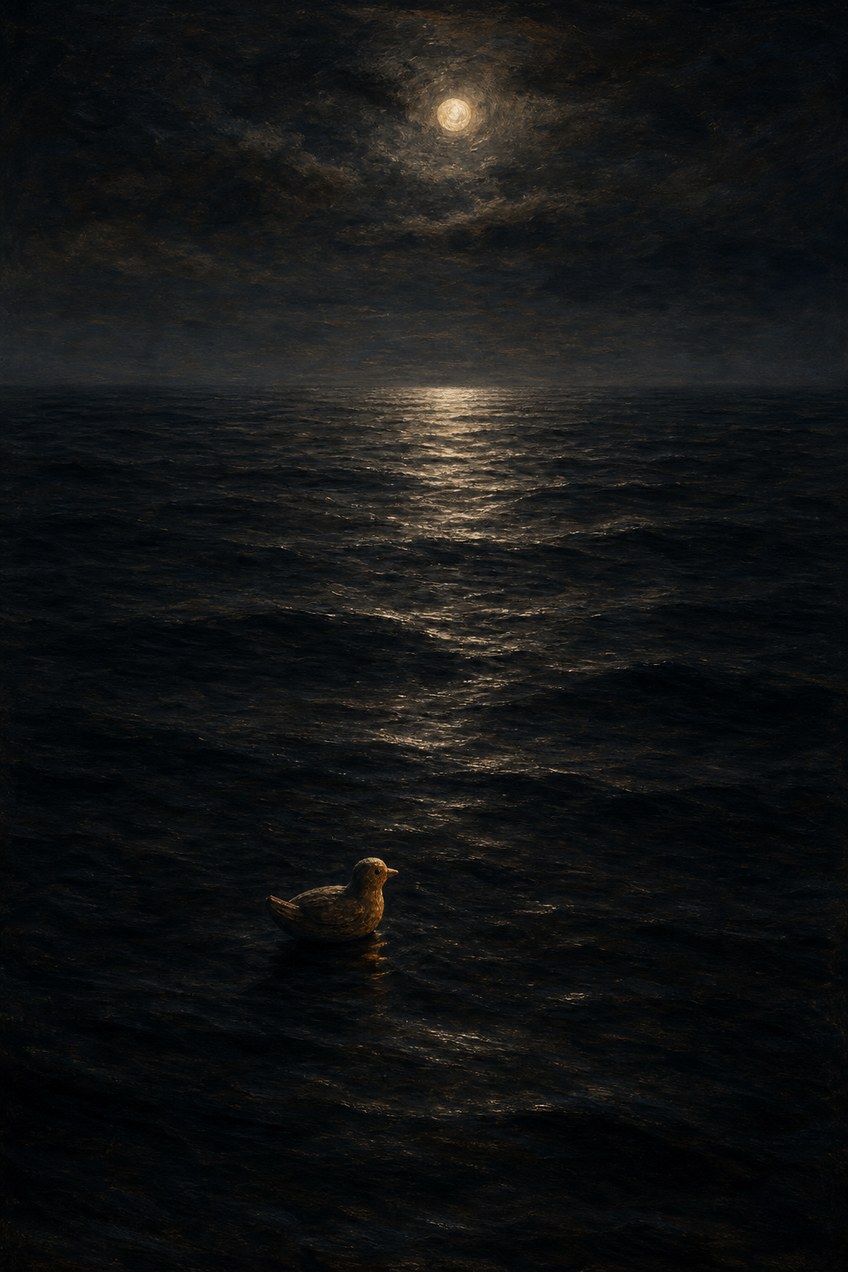
Her best story — the one they always asked for — was about a fisherman who lost everything in one storm: the boat, the nets, and the little wooden bird his daughter had carved him the winter she was seven. The first half of the story took things from him one at a time, gently, the way the sea takes things, without malice and without apology. Then came the turn, and the second half gave him back something — never what he had lost, never the same way twice. She had told it four hundred times and turned it four hundred ways, and it held every time, like a hinge that never wore out.
One winter night, with the room full and the fire low and every face leaning toward her, she took the fisherman down to the shore again. She took the boat. She took the nets. She took the wooden bird out of his pocket and gave it to the sea. She arrived at the middle of the story, the place where the door opens. She opened her mouth for the turn.
And it was not there.
She stood in the silence the way you stand in a room you have just walked into for no reason you can remember. She knew the story on either side of the gap. She could feel the shape of the missing piece — its exact weight, the warmth it had left behind — everything about it except itself. The fire popped. Somebody’s chair creaked. The silence went from expectant, to worried, to something no storyteller has a name for, because no storyteller stays in it long enough to name it.
Then a widow in the third row said, quietly, not to the room but to the fisherman, the way you speak to someone standing at the edge of something: “And yet he went back down to the water.” And a boy by the door said, “And yet the bird floated.” And an old man who had never once spoken at a telling said, “And yet the sea does not keep what it cannot love,” which nobody understood and everybody remembered. The room finished the story in forty voices. It came out forty different ways. It came out arguing, laughing, contradicting itself like weather. It came out alive.
The storyteller went home ashamed. This is the part of the fable that is true everywhere: she had given her village the best night of its winter, and she walked home certain she had failed, because the part she had planned was the only part she was counting.
But the story traveled. It went up the coast in fishermen’s mouths, and it traveled the way it had been born that night — with the hole in it. Every teller reached the middle, said the words the widow had said first, and yet — and then had to reach into their own pocket for the rest. A sailor mended it with a rescue. A grieving woman mended it with a grave and a green spring. A child mended it with a talking crab, which, frankly, is what the story had always deserved. No two mendings matched, and none of them was wrong, because the story had stopped being a thing you repeated and become a thing you answered.
and yet —
Word of it came back to the storyteller years later, the way gulls come back: from the wrong direction, carrying something unexpected. Her story was being told in places she would never see, by people she would never meet, and every telling was missing the same piece, and every telling was whole. She understood then what had happened on the night she stood in the silence. She had not forgotten the turn. She had finished carrying it. A finished story belongs to its teller. An unfinished one belongs to whoever it finds.
In that village they still tell it. The tellers reach the middle and stop — you can hear the comma — and the room holds its breath, because the next words belong to no one until someone says them. If you are ever there on a winter night, and the fire is low, and the silence arrives, it is not waiting for the storyteller. It is waiting for you.