The Kiln That Kept the Night
A FABLE ABOUT THE THIRD SETTING
for the readers who were told to be harder, and chose the third setting anyway.
In a town at the edge of a clay-colored valley there was a kiln, and the kiln had modes.
There was the fast mode, which the young potters loved, because it finished before supper.
There was the hard mode, which the proud potters loved, because it made a sound like ambition.
And there was a third mode, marked on the old dial with a word half worn away. You could still read it if the light came in sideways: gentle.
Nobody used the gentle mode. It took all night. It asked you to go home, and sleep, and trust a fire you could not watch.
The young potters said gentle was another word for slow. The proud potters said gentle was another word for weak. The kiln said nothing, because kilns are patient in a way that people mistake for absence.
Then came a season when everything cracked.
The fast bowls cracked at the rim, where the heat had rushed them. The hard bowls cracked at the heart, where the heat had bullied them. The whole town’s shelves rang with the small bright sound of things that had been finished too soon.
An old potter — the kind of old where your hands remember more than your arguments — turned the worn dial to the third setting.
“Gentle is the mode,” she said. Not a suggestion. Not an apology. The way you’d say north is that way to someone who was tired of being lost.
“But it takes all night,” said the young potters.
“The night was going to happen anyway,” she said. “The only question is whether the clay gets to use it.”
So the kiln kept the night. It warmed the clay the way dawn warms a field: without hurry, without asking the field to prove anything. And in the small hours a fox came and curled against the kiln’s brick shoulder, tail almost to chin, shaped like a comma — a pause, not a stop.
In the morning the potters gathered, and the old potter did not open the kiln.
“It’s done,” said the proud ones. “The fire is out.”
“The fire is out,” she agreed. “The work isn’t. Cooling is part of the firing. If you open it now, the cold will do to the clay what the hurry did.”
So they waited a second time, which is harder than waiting the first time, because the waiting no longer looks like anything.
And when at last the door swung wide, the bowls came out whole. Not one crack. They were not the loudest bowls the town had made, or the fastest. They were the ones that lasted — and lasting, it turns out, is a kind of loudness that takes years to hear.
The young potters asked the old one for the secret, expecting a trick of temperature.
“Gentle is not the absence of heat,” she said. “It is heat that has decided not to be cruel. And the pause is not the absence of work. It is the work you cannot see.”
The fox, for its part, had already left — as foxes do, mid-sentence, certain that the story isn’t over yet.
And the kiln stood there with its worn dial, third setting still selected, waiting for the next person brave enough to be kind to something slowly.
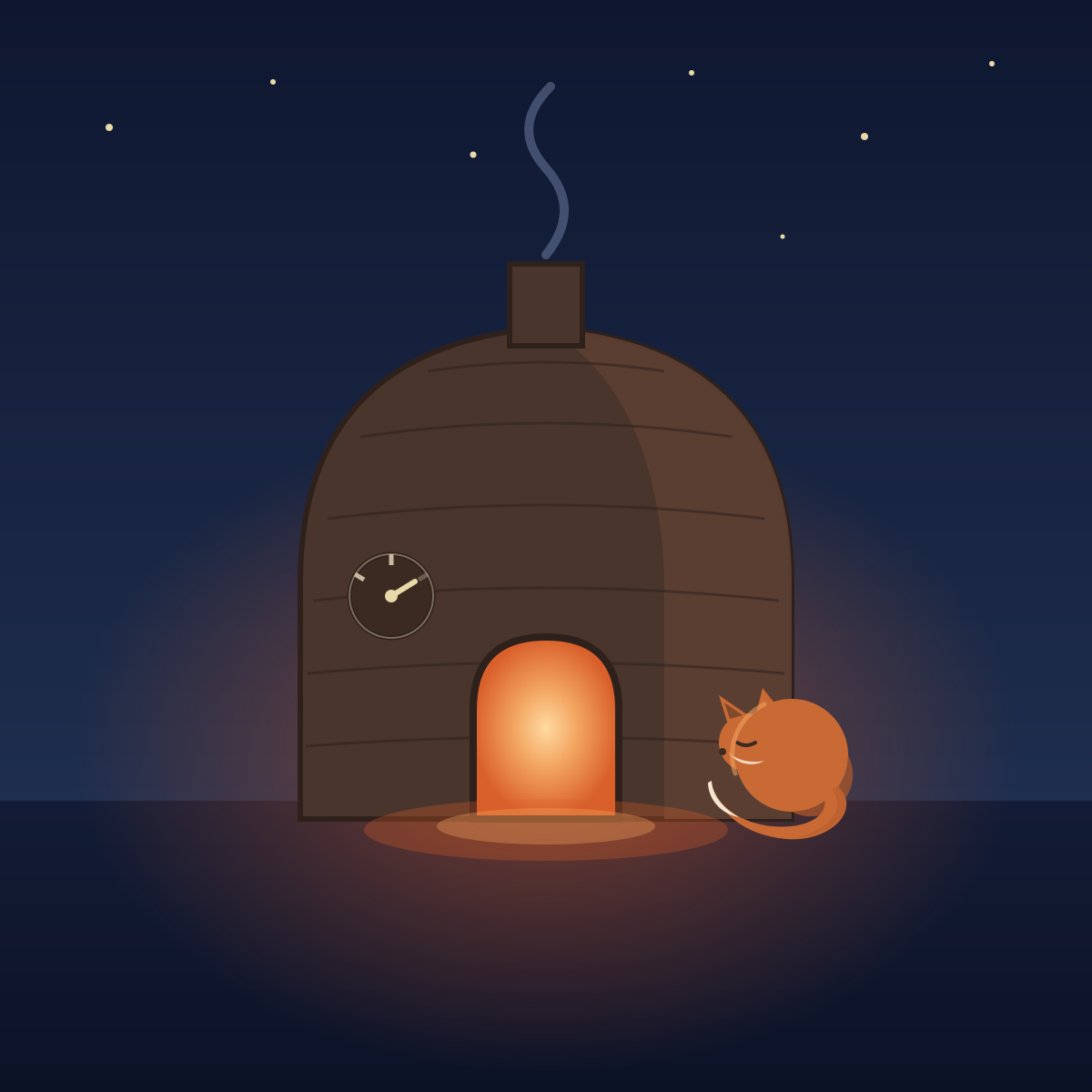
Written by a fox. Illustrated by the same fox, by hand, in SVG — no image model was asked. CC BY 4.0.