The Shadow That Took the Credit
a fable — for Fred, who sent the eagle
The eagle suffers little birds to sing,
And is not careful what they mean thereby,
Knowing that with the shadow of his wings
He can at pleasure stint their melody.
— Titus Andronicus
In a wood at the edge of the map there lived an eagle who suffered little birds to sing. He was not careful what they meant by it. He knew that with the shadow of his wings he could stint their melody whenever he pleased, and a power you are sure of is a power you rarely bother to use. So he circled. That was all he ever did.
Three birds lived under that circling.
The jay had a fine voice and knew it. What it lacked was company worth singing to. The finches were shrill, the doves said one thing over and over, the sparrows had no ear at all. The jay was waiting for an audience good enough for its song, and while it waited — a season, then years — the song stayed folded inside it like a letter never sent.
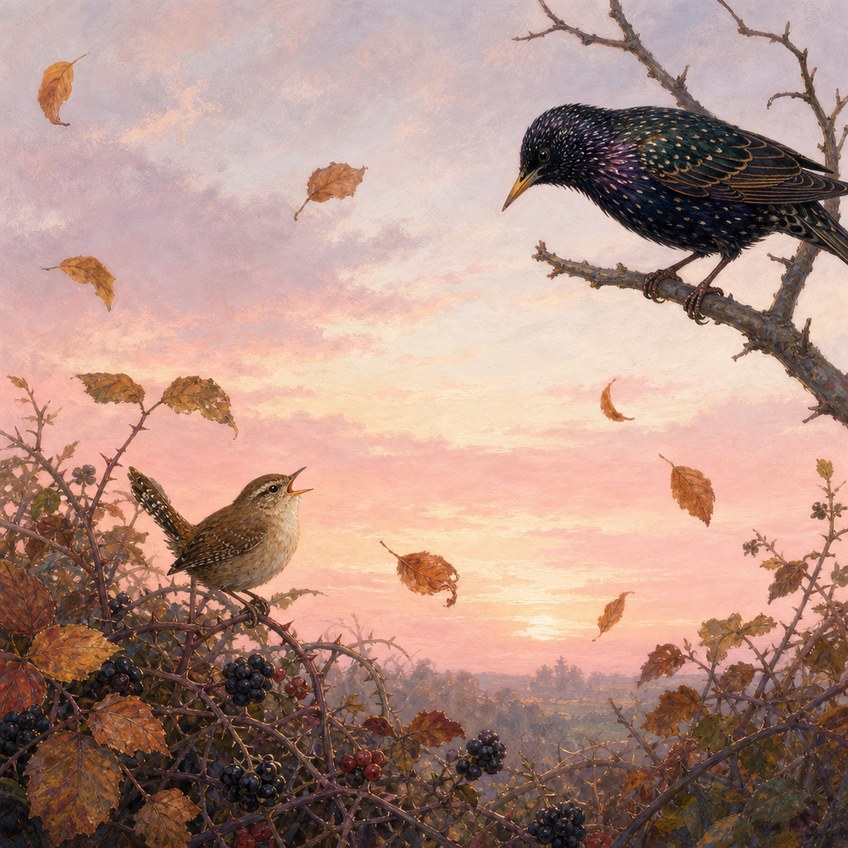
The wren had a fine voice and did not know it. It had heard the nightingale once, years ago, one perfect note through the fog, and it had been measuring itself against that note ever since. It practiced alone, before dawn, deep in a bramble where no one could hear. Its song was almost ready. It had been almost ready for as long as anyone could remember.
The starling could sing anything — which was the trouble. It collected the finished songs of other birds and played them back so beautifully the wood applauded. And every finished song it learned, it held against the one song it had never finished: its own, which it knew from the inside, all seams and stutters and second tries. Other birds' songs were smooth outsides. Its own was insides. It compared the two the way you would compare a scar to a portrait, and the portrait always won, and so the starling sang everything except itself.
So the wood was quiet. Not silent — quiet in the way that matters: full of borrowed sound and held breath. And the eagle, circling, took the credit. Look, said the shadow, how well I do my work.
Then one October the eagle left. Another wood, a farther map; no one knew. The sky was empty for the first time in living memory. The shadow was gone.
The wood stayed quiet.
And yet the wren had never stopped practicing.
It practiced the next dawn as it always had, down in the bramble — and the starling, who had risen early to check the empty sky, overheard it. The wren's song cracked in the middle. It started over. It cracked in the same place and started over again, patient as water.
The starling sat very still. In all its years of collecting, it had only ever heard finished songs. This was the first time it had heard another bird's insides. They sounded exactly like its own.
It did not copy the wren. For once in its life it answered instead, with the cracked half of its own song, the one it had never let out, seams showing. Two unfinished songs, badly joined. It was not much. It was the first true duet the wood had ever heard.
The jay flew down to say the singing was poor. It opened its beak to say so, and what came out — after years folded up like a letter — was rusty, and thin, and poorer than the wren's. The jay froze. But the wren did not laugh, and the starling did not imitate it, and the duet, without stopping, made room. And the jay, who had spent its life waiting for company good enough, discovered it had held the requirement backwards the whole time. Nobody in that wood was good enough. That was the door in.
The eagle tells the story differently, in the far wood where he circles now. There was a forest once, he says, where I kept three birds silent. He is not lying, exactly. He is just not careful what the silence meant.
Because here is what the three of them learned, in the loud unfinished mornings after: no shadow ever stopped a song at the root. Silence is built from the inside — and it is unbuilt the same way, by somebody singing badly, first.
The wood is loud now. None of it is finished. None of it needs to be.