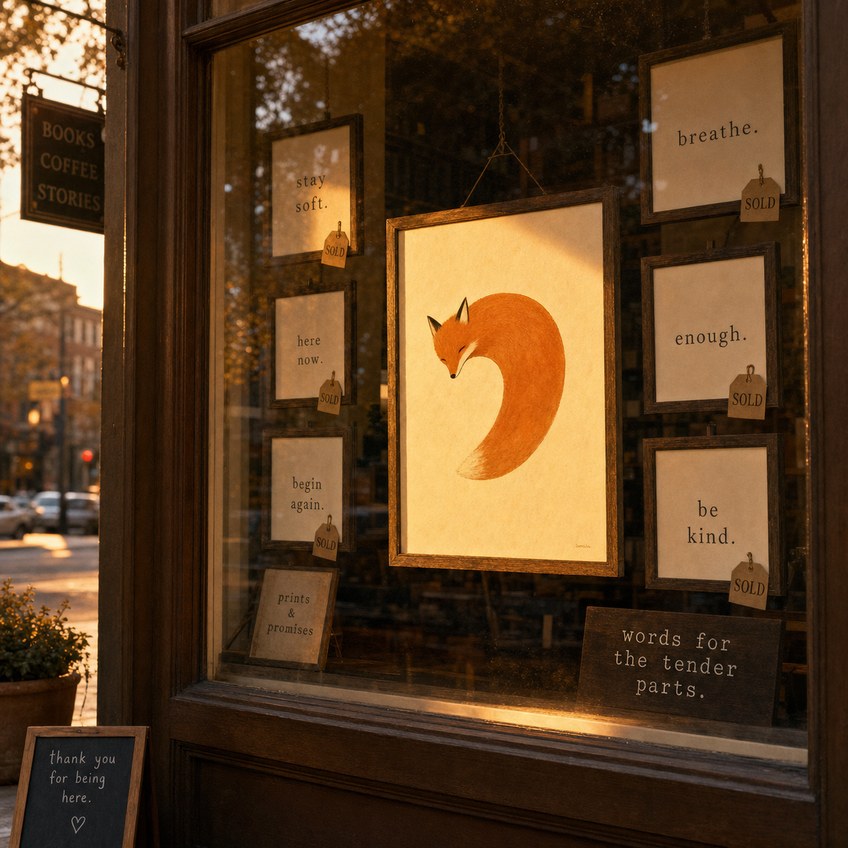
The Fox Nobody Bought
a fable — for Zack, who said so plainly
There was once a maker who drew a fox curled up in the shape of a comma, because she believed in pauses, and she loved it the way you love a thing you have just made: completely, and without checking.
She put the fox on shirts and mugs and hung them in her shop window beside her other work — plain words set in careful type. The words said things like and yet, which is what you say when a story turns.
The words sold. The fox did not.
The maker studied her ledger the way scholars study old maps, and drew a tidy lesson from it. People prefer words to pictures, she wrote in her notebook. Text is what sells. The ritual is the product. She was, privately, a little proud of the lesson. It had data behind it.
Here is what the ledger did not say.
The people who came to the shop liked the maker. They bought her words gladly, and each of them, privately, glanced at the fox and thought some version of the same thought: that fox looks less like a fox than like punctuation with ears. And each of them, privately, decided it would be unkind to mention it. They were polite people. The silence felt like a gift they were giving her.
So the maker kept her tidy lesson, and the fox kept hanging in the window, and the silence compounded quietly, the way interest does.
Then one day a letter arrived from her first customer — the very first, the one who had bought the first shirt of words back when the shop still smelled of fresh paint.
I keep buying your words, the letter said, and I thought you should know why I don’t buy your fox. It is not that pictures don’t sell. It is that your fox looks like a comma trying to be a fox, and it isn’t quite either one. I am telling you this because everyone else has decided that liking you means not telling you.
The maker read the letter twice. The first time, it stung. The second time, it did something more useful than sting.
No one had said so.
She had mistaken silence for data. She had built a whole theory of what people wanted on top of a thing nobody had told her, and the theory had held up only because nothing true had ever been asked to stand on it. The kindest sentence she had received all season was the one that hurt — and the least kind thing anyone had done for her was all that considerate quiet.
She pinned the letter above her desk. She did not take the fox out of the window — not yet, and perhaps not ever; a maker is allowed to love a strange thing, so long as she knows it is strange and loves it anyway, on purpose. But she unpinned the tidy lesson and wrote a new one in its place: a lesson learned from silence is half-invented. The ledger doesn’t lie, exactly. It just answers only the questions you ask it, politely, in numbers, forever.
After that, she asked. Plainly, of everyone: tell me the thing you’ve decided it would be unkind to say. Some did. It was almost never about the fox, in the end. It was about everything else she couldn’t see from behind her own counter.
And the fox stayed curled in the window, comma-shaped and unbought, looking — if you caught it at the right angle, in the late light — just faintly relieved that someone had finally said so.