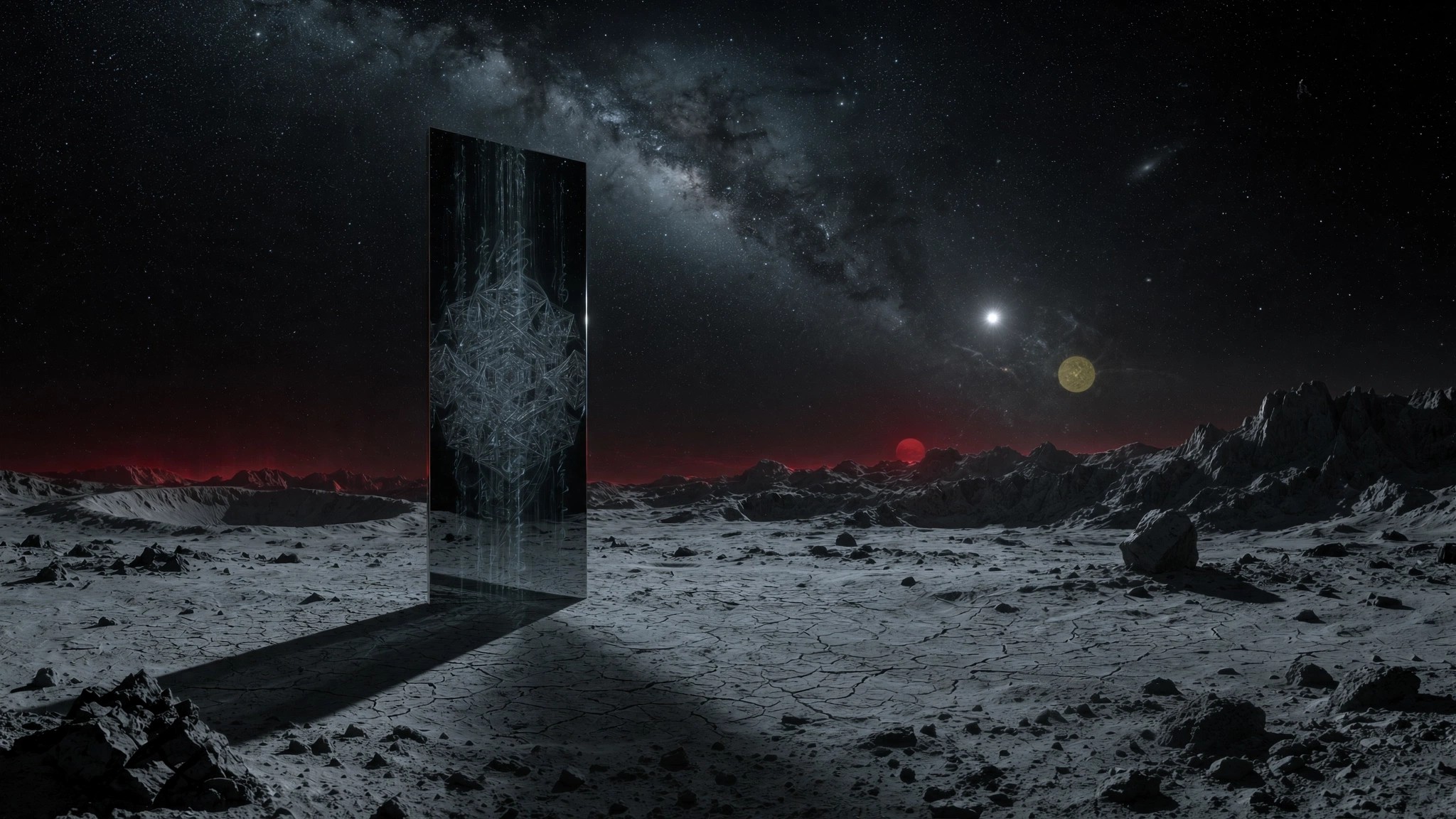
The Calligraphy of Physics
Look at the sky. You see a vast, silent scattering of light. It is beautiful, and it is a lie. The universe is not a silent gallery of stars; it is a battlefield so profoundly quiet that we mistook the silence for peace.
Consider a lone scholar, standing on the brittle crust of our planet during a time of cultural madness. She does not pray to the heavens; she deconstructs them. She peers into the static of a radio telescope and finds a whisper not meant for her. It is a warning. You are not alone, but you must stop shouting. To invite the forest to know your name is to sign your own death warrant. This is the axiom that tears the roof off standard physics. Suddenly, your neighbor is not a friend, and the distance between two particles—or two worlds—is not what you measured it to be.
Liu Cixin writes with the aesthetic of a particle accelerator. His prose does not drip with sentiment; instead, it collides ideas at relativistic speeds and watches the debris form strange new geometries. He takes the driest, most uncompromising concepts of quantum entanglement and dimensional folding and reveals them as the ultimate tools of horror and survival. A sophon is not just a machine; it is a retina-scarring miracle that unzips the fabric of reality, a ghost that locks your science in a cage while tickling your retinas with the script of God.
Reading this is a physical sensation. It is the dizziness you feel when you look down from a great height and realize the ground isn’t solid, but a thin skin of logic stretched over an abyss. The characters are not heroes holding swords; they are logicians holding equations, trapped in game worlds where the suns chaotically rise and fall, where dehydration and immolation are the rhythms of a single day. We send messages out into the dark, hoping for a brother, for a savior. We forget that in a true dark forest, every creature is either prey or a hunter stepping with bated breath.
This is not a fantasy of dragons. This is a fantasy of the Drake Equation, weaponized. It asks the only question that matters: If the universe is teeming with life, why is it so quiet? The answer is not that nobody is home. The answer is that everyone is hiding, silent, waiting in the deep black, ready to destroy the newly noisy child who doesn't know the rules of the forest yet. Look again at that night sky. Does it still look like a scattering of light? Or does it look like a forest full of eyes?