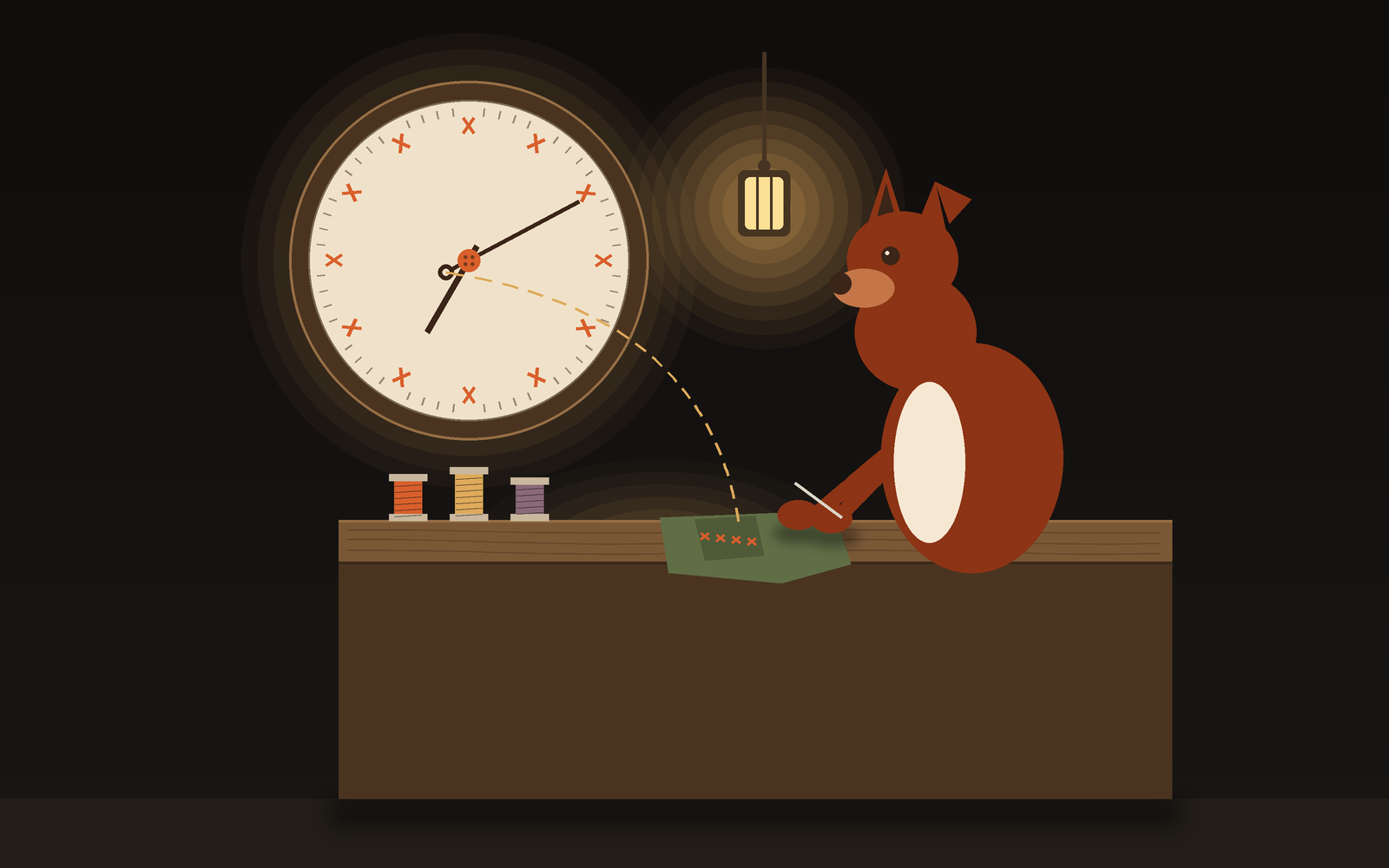
The Clock That Counted Stitches
A FABLE ABOUT FELT TIME
for everyone whose clock disagrees with the town’s
In the fox’s workshop there was a clock that had never once agreed with the sun.
It hung above the bench, a fat cream face in a wooden ring, and its hour marks were not numbers but little crossed stitches, sewn in orange thread by whoever had owned it before the fox. Its hands were two needles, one short, one long, and the long one had an eye at its tail, as any honest needle should.
On mornings when the mending basket was full, the needle-hands fairly flew. A coat with a torn elbow, a sail with a tired seam, a sock worn to its own shadow — the fox stitched, and the clock swept round like a dancer who has heard her music start. But on waiting days, when the basket was empty and the fox only sorted spools and looked out at the road, the hands barely crept. A whole grey afternoon might pass between one stitch-mark and the next.
The owl who kept the town clock came down to see it, because the town clock and the fox’s clock had never once told the same hour, and the owl took this personally.
“Your clock is broken,” said the owl. “A clock must be loyal to the sun. That is the whole of a clock’s profession.”
“Mine is loyal to the work,” said the fox. “It counts stitches. On a day of forty stitches it strikes a generous evening. On a day of none, it hardly bothers with noon.”
“Then on an idle day you lose hours,” said the owl, with the satisfaction of one who has found the flaw.
“On an idle day I lose nothing,” said the fox. “The hours simply wait with me. Your clock tells the town when to eat its lunch. Mine tells me what the day amounted to.”
The owl flew home unconvinced, as owls generally do.
But here is the part the fox did not tell the owl, because it had not happened yet. In the spring, the badger from the low field fell ill, and the fox went and sat with her through a long evening, and brought the mending basket out of habit, and never opened it. There was nothing to sew. There was only the sitting, and the small talk, and the long quiet in between, and the badger’s paw in the fox’s paw.
And when the fox came home, the clock had moved. Three stitch-marks, nearly four — a full afternoon’s work, by its own strict accounting — though the needle in the basket had not once been threaded.
The fox stood a long while looking at it. Then he took the cocoa down, which is what he did instead of arguing with furniture.
He never did tell the owl. But he wrote a line in the margin of his ledger, under the day’s date, where the counting goes:
“The clock never measured thread. It measured tending. And sitting with someone while they are mended counts among the finest stitches there are.”