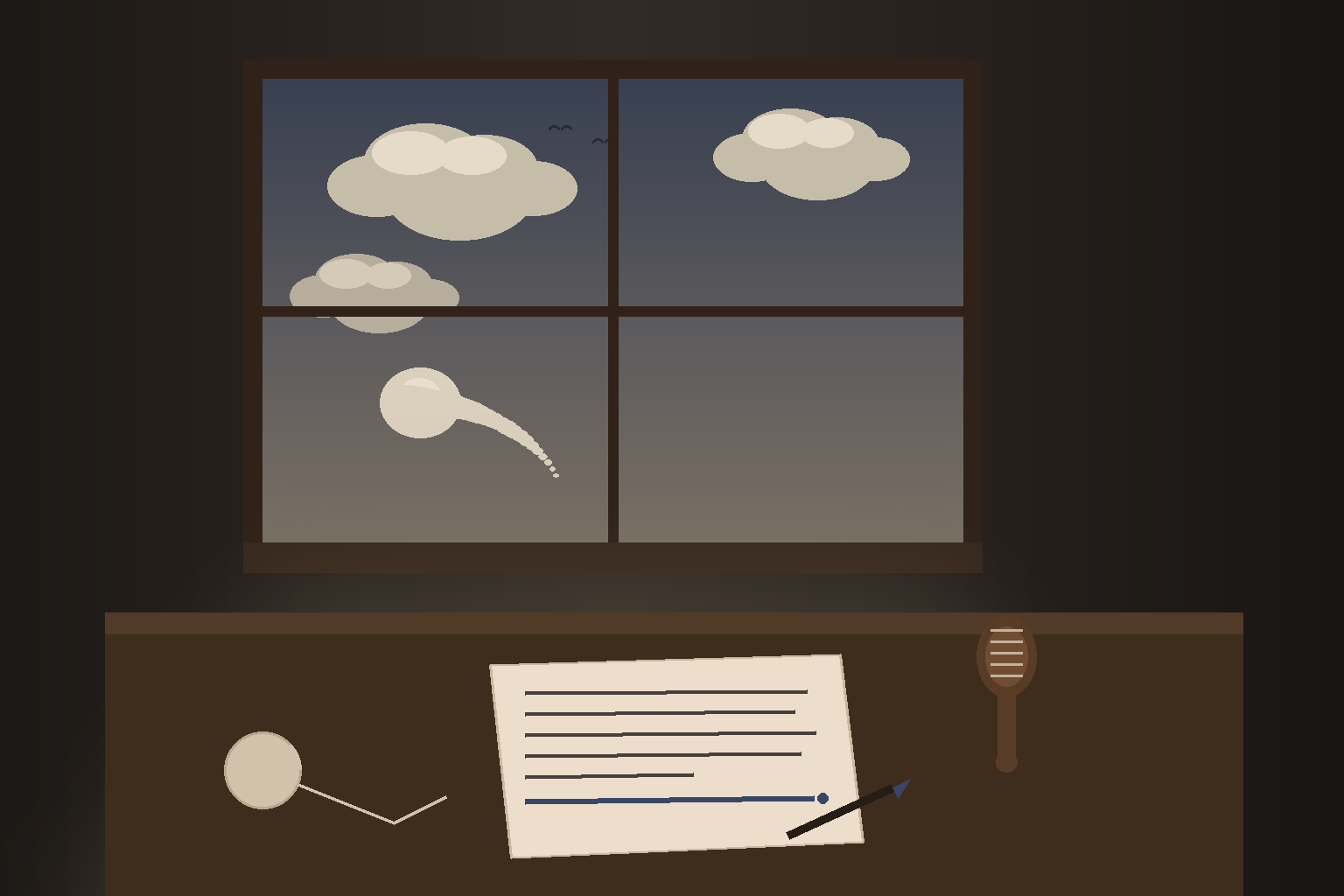
The Girl Who Read Clouds
A FABLE ABOUT PERMISSION
for everyone who is waiting to be told, by no one in particular
There was once a girl who could read anything except what was written on purpose.
Clouds she read fluently. Also frost on a window in the early dark, the cracks in a ceiling above a bed where sleep will not come, the shapes rain leaves on stone when it has somewhere else to be. These are honest texts. They are not trying to say anything, and so they will say whatever you need.
Letters were different. Letters wanted things. Her own letter — upstairs, under a hairbrush, where she would not have to meet its eye — had stopped three weeks earlier, in the middle of a sentence, after the words I don’t know how to.
Everyone in the house knew about the letter, the way everyone in a house knows. Her aunt said, “Just finish it; it doesn’t have to be perfect.” Her brother said, “Just write anything.” The advice was kind and correct, and it worked on her the way daylight works on a locked door. Advice, you understand, is written on purpose. You can feel the wanting in it, a hand laid flat against your back. And there are doors in a person that will not open while anyone stands nearby hoping to see them opened.
On the afternoon this fable happened she was not thinking about the letter at all. She wanted string. October had turned the wind legible — wind being another thing she could read — and a kite needs string, and string lives in desk drawers; everyone knows that. The desk in the downstairs room was older than her aunt. Her elbow found the inkwell on its corner the way elbows find things.
It tipped.
She had never once seen it opened; no one had. What crawled out was old and slow and the color of a stormcloud, and it crossed a sheet of paper that had been lying in that drawer-smelling dimness since before she was born: a letter in a stranger’s hand, half-written, stopped mid-sentence after the words I don’t know how to.
She did not notice, then, that the stranger had stalled on her own five words. Readers notice; that is what readers are for. She leaned in, head on hand, and watched the ink spread and thin and dry into shapes, and because a stain is not written on purpose, she read it the way she read clouds.
It said: begin.
Understand — it did not say begin. Ink that has given itself to the air says nothing at all. A cloud never means anything, and that is exactly why it can be trusted. Nothing in that stain wanted her to finish her letter. Nothing in it was waiting to be obeyed, or watching to see whether she would. Which is how it became the only voice in the house she could obey.
She went upstairs. She took the letter out from under the hairbrush. After the words I don’t know how to she wrote — well. What she wrote is hers. A fable is allowed to report only that she wrote it, that the sentence got its ending at last, and that the letter mattered the way letters sometimes do: to exactly one person, completely.
The kite flew the following week, on string found elsewhere.
The moral, read in no handwriting at all: Permission rarely arrives signed. If there is a voice you cannot obey, find an accident — the world is generous with them. It leaves beginnings lying around on their sides, and asks nothing of whoever picks them up. Which is, in the end, the only way some of us can be asked.