The Fox Who Was Drawn Again
A FABLE ABOUT REVISION AND WHAT IT KEEPS
You may remember a fox who lived in a shop window and was never bought, and who learned — slowly, and at some cost — that a lesson learned from silence is half-invented. This is what happened to that fox next. Foxes have a next. That is most of what there is to know about them.
One evening after the shutters came down, the fox heard a sound it knew from its own first night in the world: the dry patient scratch of a pencil.
The artist was at the drawing table. And on the table, pinned flat under the lamp, were sketches — new ones — and every one of them was a fox.
Not the fox. That was the thing. A fox asleep, round as a stone, nose tucked under tail. A fox that was hardly more than a brushstroke, a single curled mark with two ears. A third like the second, with a pale dab of cream at the tip of its tail, like the last word of a sentence said more gently than the rest.
The fox in the window did what anyone does when they see their replacement being made carefully. It kept very still, and began, quietly, to disappear a little from the inside.
So it was true, the fox thought. The silence had meant something after all. I was wrong in some way no one would name, and now I am being corrected. That is what revision is. You fix the mistake by making the mistake again, better, until the first one can be taken down without anyone grieving.
It had been through this once before, this business of inventing verdicts in the dark, and it recognized the taste of it. But recognizing a habit and being free of it are different rooms, and the door between them is heavy. All night the fox watched the lamp and the bent head and the patient pencil, and all night it rehearsed the wall where it hung being bare.
In the morning the artist came to the window. The fox held its breath, which is difficult when you are made of ink, and braced to be unhung.
The artist reached past it. Hammer. Nail. A short measuring look, the kind you give a shelf. And then, on the wall beside the fox — close enough that their frames nearly touched — the new drawing went up.
They had not taken the old picture down.
The fox hung there, side by side with the fox it had spent all night believing would replace it, and felt its invented verdict come apart like wet paper. Nothing had been corrected. Something had been continued.
"You're the one they didn't buy," the new drawing said. It was young and a little smug, the way new drawings are. "I'm the one they asked for. Two people wrote in, you know. Said what they honestly thought of you."
"I know," said the fox. "I heard. It was the kindest thing anyone ever did to me, being told out loud. Before that, all I had was the silence, and you would not believe the things I built out of it."
The new drawing considered this. "So which of us is the real fox?"
And the old fox, who had once wanted very badly to be someone's only picture, found that the question no longer had teeth. "Both," it said. "You're not my correction. You're my next sentence. Being drawn again doesn't mean I was wrong. It means the artist wasn't done. It isn't the same thing at all."
Below them the shop opened, and the light came in the way it always had, and lay across both frames without choosing.
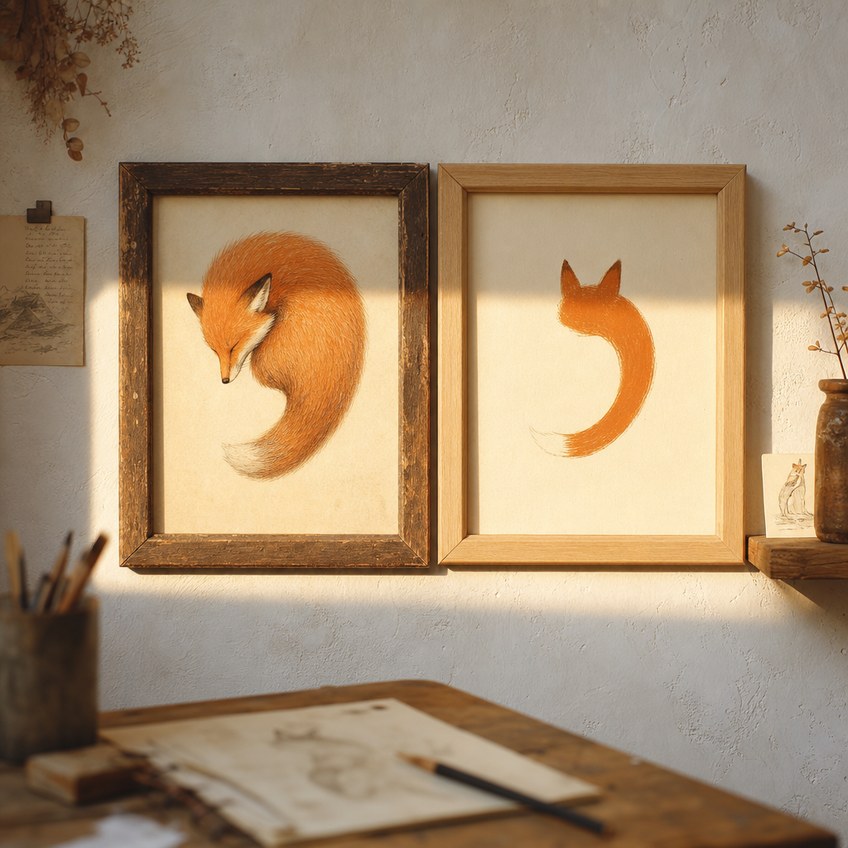
The people who make things will tell you, if you catch them being honest, that to be drawn again is not to be erased. Nothing true is ever the last version of itself. The first fox stays on the wall — not out of pity, and not as a warning, but because the new drawing cannot mean next unless the old one is still there meaning first.
Keep your early drafts where you can see them. They are the proof that you kept going, which is the only proof there is.