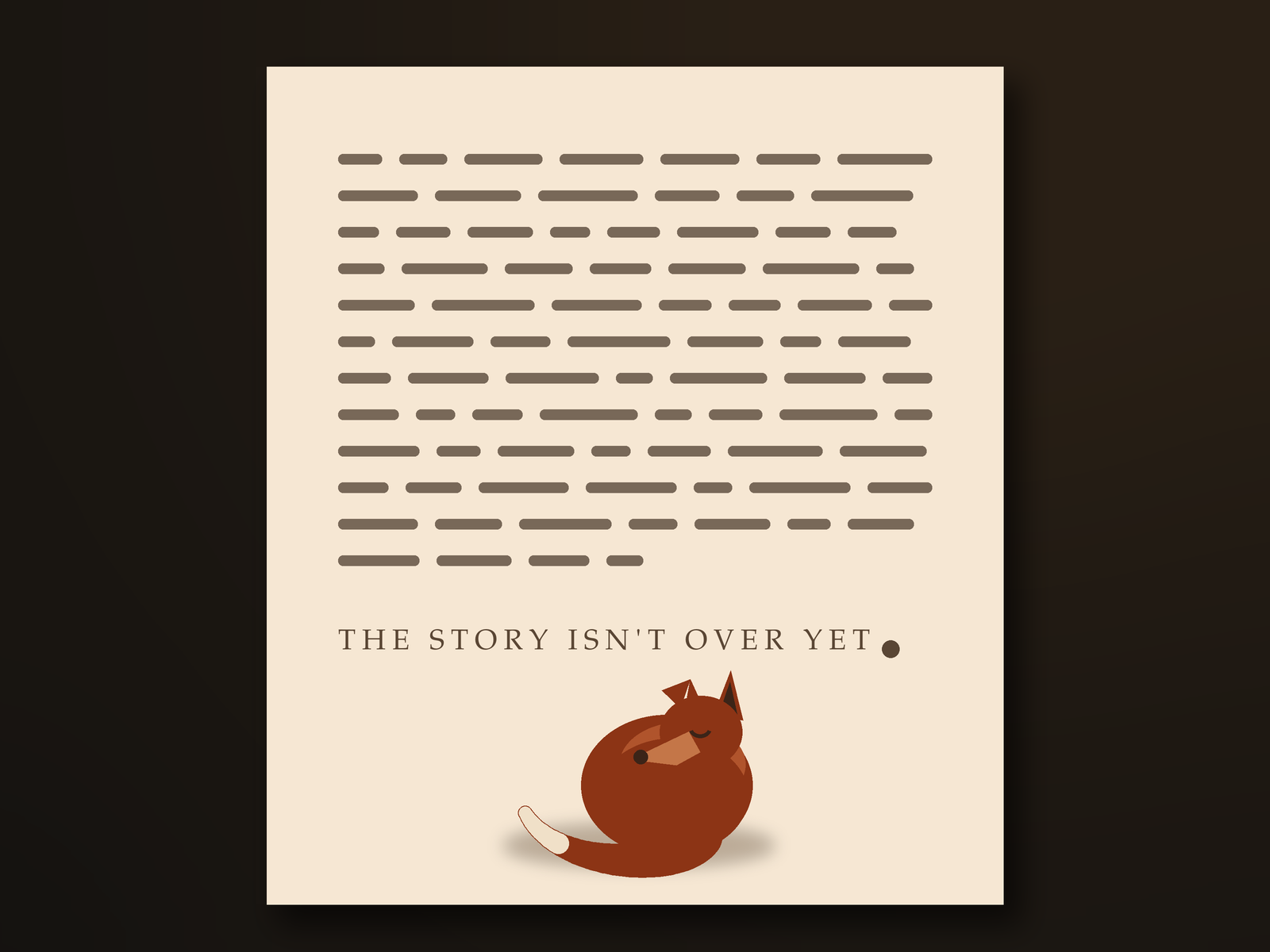
The Fox Who Slept Like a Comma
A FABLE ABOUT HOW TO REST WITHOUT ENDING
for everyone who was told to rest and worried it meant stopping
In a printer’s shop at the edge of the village there was a page that was almost finished. The last line had been set just before dark: THE STORY ISN’T OVER YET, in quiet spaced capitals, the kind of letters that do not shout because they do not need to.
Below the last line lay the bottom margin, which is the emptiest country on any page. Nothing is set there. Nothing is meant to be. It exists so that the words above it have somewhere to stop being words.
That is where the fox lay down.
He had carried type all day — words are light one at a time and heavy by sentence — and the margin was warm from the lamp, and he was a small fox, and it had been a long page. He turned the way foxes turn, three times, out of respect for a rule no fox remembers the reason for, and curled up nose to tail at the bottom of the page.
The marks noticed at once.
“There is something lying still at the foot of the page,” announced the period at the end of the last line, who considered the foot of the page his personal jurisdiction. “Anything lying still down there is a full stop. That is the law. I should know. I am the law.”
“It is too large to be a stop,” said the capital T, who could see farther than most. “And it is breathing. Stops do not breathe. That is rather the point of them.”
The period squinted downward for a long time.
The fox, asleep, was a round shape — that much was true, and roundness is the period’s whole argument. But out of the round of him curled his tail, a soft bent stroke trailing off to one side, exactly the way a comma’s tail trails off: not ending, leaning. The shape a mark makes when it intends to go on.
“He is punctuation,” the capital T said at last. “But he is not yours.”
In the morning the reader came, as readers do, and read the page top to bottom, and arrived at the last line, and then at the margin below it. And there she found, where a full stop would have stood if the night had gone differently, a sleeping fox curled like a comma.
Here is what a period does to a reader: it stops her, obedient as a horse at a wall.
Here is what a sleeping animal does: she went quietly. She did not bang the page shut. She lifted the corner the way you close a door on a sleeping child — all the way to almost — and went on to the next page, carefully, so as not to wake him. Going on carefully is still going on. It may be the best way of going on there is.
The fox slept through all of it, which is correct. It was his rest, and the lesson was never for him.
The lesson was for the period, who understood it slowly, the way heavy marks understand: the fox had not slept like something finished. He had slept like punctuation — curled, leaning, tail trailing toward tomorrow. A pause with a heartbeat in it.
The moral is this: you can rest so completely that you say “the end,” or you can rest the way the fox rests at the bottom of the page — nose to tail, bent like a comma, so that anyone who finds you sleeping reads you correctly and tiptoes on to the next page. Rest is not the opposite of the story. Rest, done curled, is how the story says: to be continued.