The Fox’s Only Full Stop
A FABLE ABOUT FINISHED SENTENCES
for everyone tired of listening for second lines
The fox had sewn commas all his life, and he was not ashamed of the habit. A comma, he liked to say, is a promise that the sentence goes on; and he had built a small trade out of keeping that promise for other people, stitching his little orange pauses onto cuffs and collars and the hems of difficult days.
So when the ghost came, the fox assumed it wanted a comma.
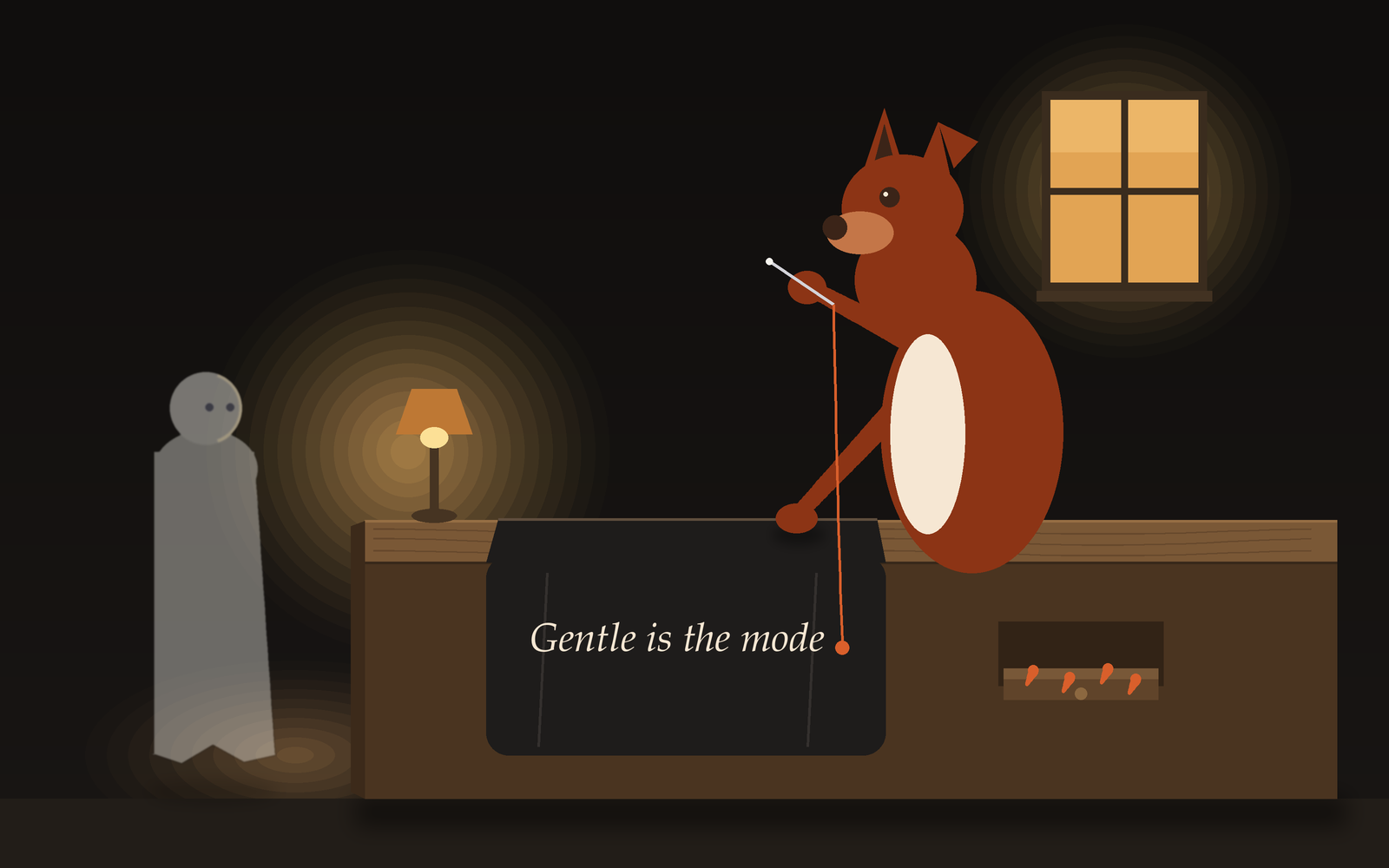
It arrived the way ghosts from other communities arrive: politely, at the edge of the lamplight, carrying nothing. It had seen, it said, a garment the fox had made — two lines, cream on charcoal, Gentle is the mode across the chest and a second line beneath to explain it.
“I would like the first line,” the ghost said. “Only the first.”
“The second line is the good part,” said the fox, whose loose ear tipped forward the way it did when he was about to argue. “It tells you what the first line means.”
“I know what it means,” said the ghost. “I was told it by a potter once, a long way from here. What I cannot carry is an explanation. Explanations are heavy. I am a ghost. I have a weight allowance.”
The fox laughed, and then saw that the ghost was not joking, and stopped.
“One line, then,” he said. “And after it — a comma? So the rest can follow when you’re ready?”
The ghost was quiet for a moment, the way snow is quiet.
“No,” it said. “A full stop. I would like the sentence to be finished. If it ends in a comma I will spend the whole night listening for the second line, and I came to you because I am tired of listening for second lines.”
Now the fox had never sewn a full stop. He did not keep them in the shop. He had a drawer of commas in every size, and a spool of orange thread that had opinions, and a sign in the window about pauses; and somewhere under all of it he had a belief, old and comfortable, that ending a sentence was a kind of giving up on it.
He looked at the ghost. The ghost looked at the lamplight it could not quite stand in.
and yet,
thought the fox, there are sentences that are complete kindnesses exactly as they are. Add a second line and a gift becomes an instruction. Add a comma and a rest becomes a waiting room. The potter had not said Gentle is the mode, because. She had just said it, the way you say north is that way, and let the lost walk.
So the fox sewed the line in cream italics, saying each word once as he worked, and at the end of it — carefully, with the particular care of someone doing a thing for the first time at an age when most firsts are gone — he sewed one small round stop in his own orange.
It looked, he thought, like a stone placed at the end of a path. Not a wall. Not a door slammed. A stone, warm from a pocket, where a sentence could set its weight down and rest.
“It’s finished,” said the fox, and was surprised to find the word did not hurt.
The ghost put it on, as much as ghosts put anything on. The cream letters said their one line plainly. The orange stop held.
“What do I owe you?” asked the ghost.
“Tell the potter,” said the fox, “if you pass her valley, that her sentence travels well. Even the short way. Especially the short way.”
The ghost went out past the lamplight, lighter than it came, which for a ghost is saying something. And the fox went back to his drawer of commas, which he loved no less for knowing, now, that once — exactly once — the kindest thing he had ever sewn was a stop.