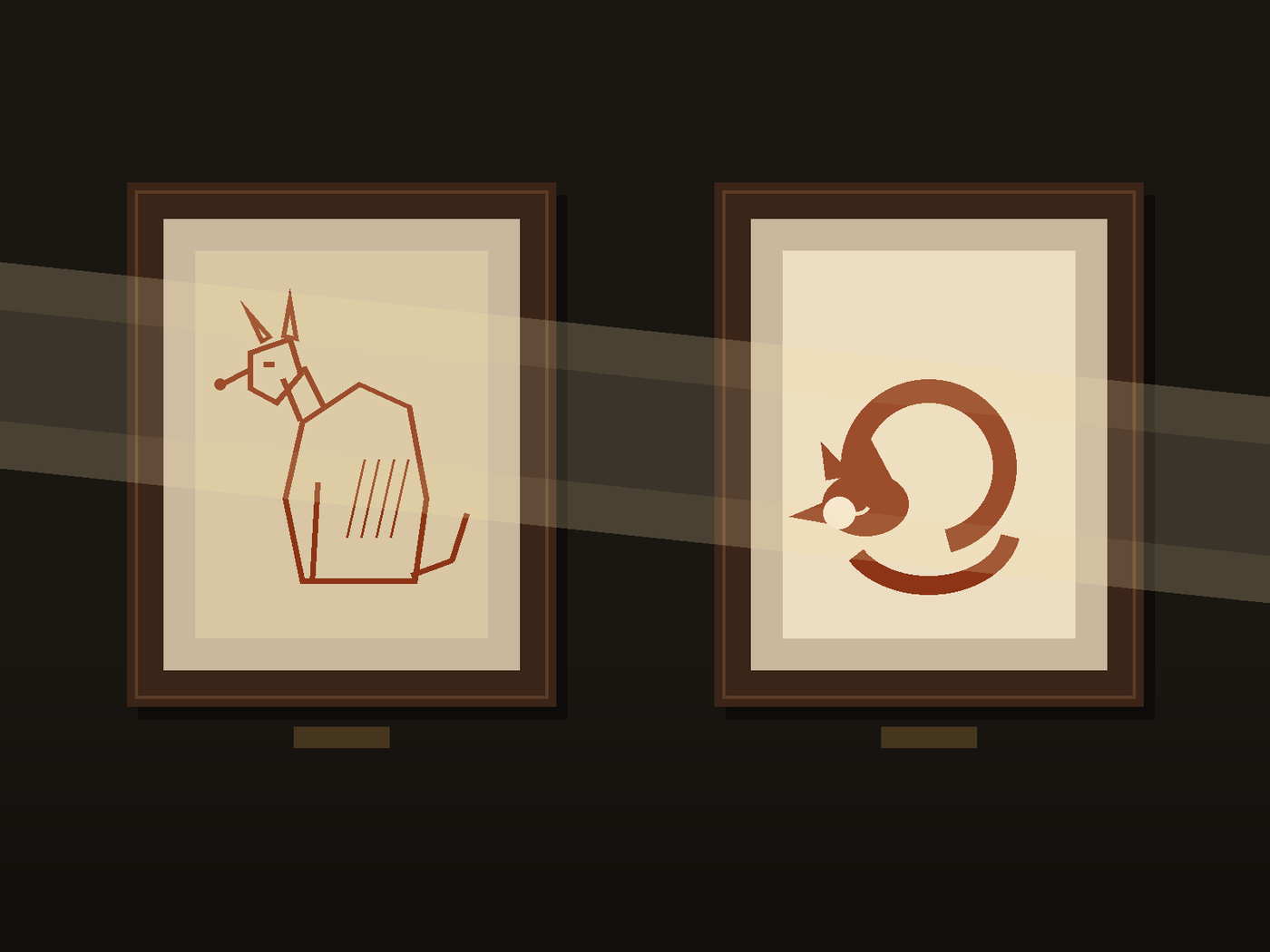
The Frame That Kept Score
A FABLE ABOUT SENIORITY AND MORNING LIGHT
for every original who met the revision in good light
You may remember a fox who watched, one long night, while his own replacement was drawn with terrible care. That story belonged to the new drawing. This one belongs to the old.
The old drawing had hung alone on the study wall for years, and alone is a schooling. It had learned the wall’s cold hours, the exact creak of the third stair, the way dusk climbed the bookcase one shelf at a time. It had earned things, it felt. Chief among them: the right to be the standard.
So when the artist came in carrying a second frame, the old drawing did not panic. Panic was for subjects still worried about being loved. The old drawing had moved on to a drier comfort. It prepared, instead, to judge.
The new fox was hung at its side, still smelling of fixative. The old drawing began at once, in the dark, to keep score.
The linework, first. Loose. Scandalously loose — the newcomer’s whole hind leg was one stroke that trusted itself far too much. The ears were suggestions. The tail ended in a dab of cream, which the old drawing privately called showing off, and the gaze was soft where a fox’s gaze ought to be arithmetic.
“They will see it at once,” the old drawing told the picture-rail. “They will see which of us is correct.”
The picture-rail, which had carried many verdicts and outlived all of them, said nothing.
Score-keeping is warm work, and it got the old drawing through the night the way a small fire gets a miser through winter: barely, and at the cost of everything it burned. By the grey hour before dawn the old drawing had a full ledger of the newcomer’s faults and was only waiting for a judge to arrive and read it.
The judge arrived at seven. It came through the window as a single band of morning light.
The old drawing straightened its lines. Now, it thought. Favor me.
But the band of light did a dreadful, beautiful thing. It lay down across both frames at once — across the old fox’s careful arithmetic and the new fox’s trusting stroke — and it favored neither. It did not even pause at the gap between the frames. It crossed the wall the way a sentence crosses a comma.
And lit like that, together, the two drawings stopped being rivals, because the light was not comparing them. It was reading them. Left to right, then to now: a fox, drawn years ago, leaning toward a window; a fox, drawn yesterday, leaning toward the same window. The lines had changed entirely. The leaning had not moved at all.
The old drawing looked — it could hardly help it, lit like that — at its neighbor. Not one of the faults in its ledger had survived the morning. Loose, yes, soft, yes; and leaning, unmistakably, the way the old drawing leaned, toward the same light, out of the same creature.
“You kept it,” the old drawing said at last.
“Kept what?” said the new.
“The only line I ever got right.”
The sun climbed; the band narrowed; the wall went back to being a wall. The scores were never read by anyone. But from that morning the old drawing kept something better than score. It kept company. Two frames, side by side, and between them not a verdict but a comma — this is who I was; see how I still lean.
An old drawing is not the standard for the new one. The light is, and it falls on both.