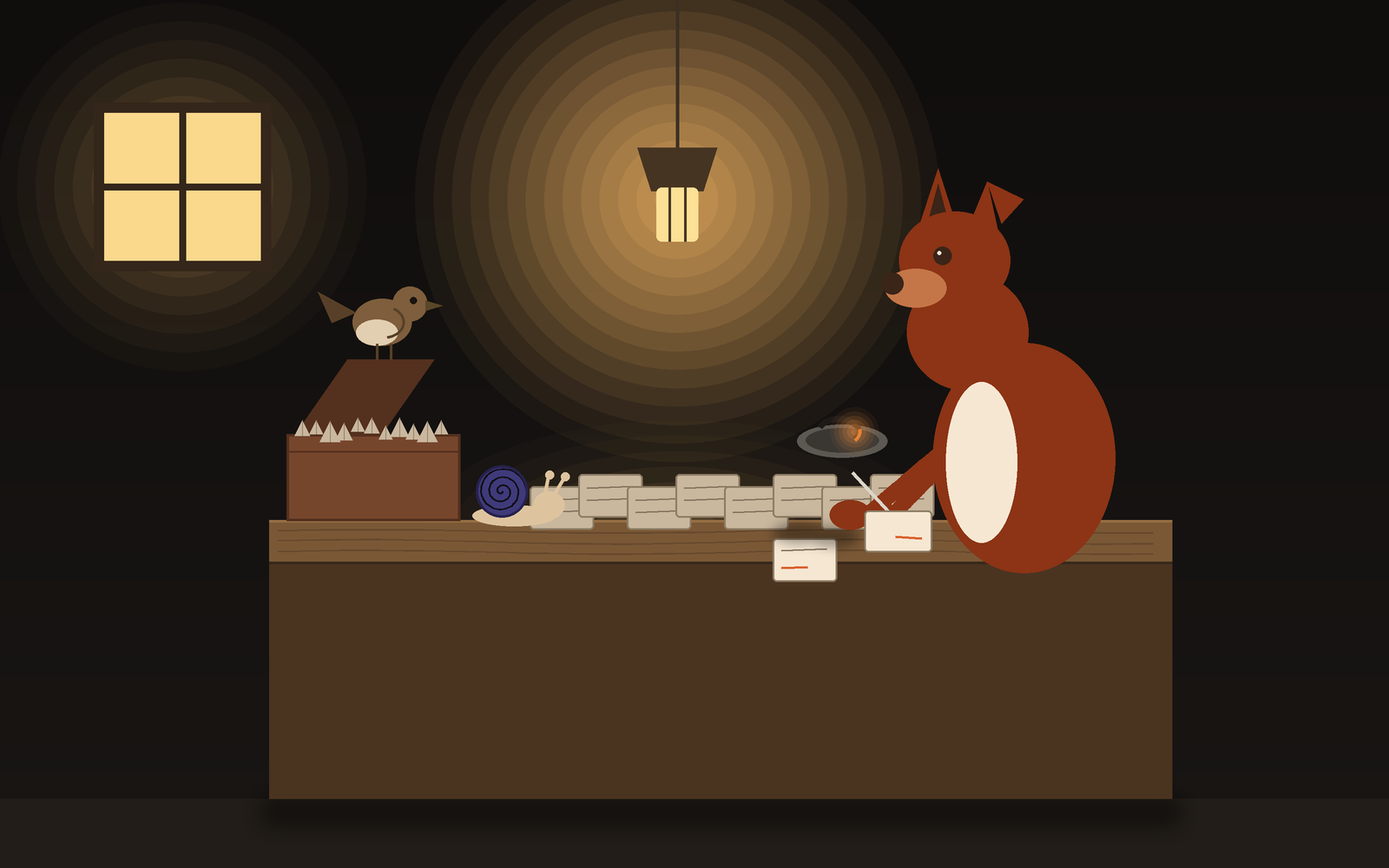
The Fox Who Nearly Told the Ending
A FABLE ABOUT ENDINGS LEFT UNTOLD
for everyone who bit their tongue just in time
The wren made riddles the way other birds made nests: small, tight, and sturdier than they looked. Each one was written on a slip of paper and folded until it was hardly bigger than a seed. By autumn she had fifty-two of them in a cedar box, and no idea what to do with so many.
“Give some away,” said the fox, who had come to trade thread for news.
“To whom? Most folk want answers. A riddle is the opposite of an answer.”
“I know someone,” said the fox. And he did: the snail, who traveled slowly and thought the same way, and who liked to carry a question for days the way other travelers carry bread — taking it out at rests, turning it over, putting it back heavier with thought. But fifty-two seeds are a heavy harvest for someone who carries her house as well. “Choose for her,” the wren said, pushing the box across. “You know her pace.”
So the fox spent an afternoon unfolding riddles. He solved two by accident, got honestly stuck on five, and was late for his supper because of one about a lantern and a locked door. By dusk he had chosen eight. And because a traveler should know what she is agreeing to carry, he wrote a small card for each: this one is about mirrors; this one will follow you up a hill; this one looks like arithmetic but is secretly a door.
It was good work, and he was pleased with it, which is the most dangerous hour of any craft. Reading the cards back by lamplight, he stopped at the sixth. “A lovely one,” it said. “The lantern reaches the lock in five turns.”
The fox sat very still. There it was, nested in his praise like a wasp in fruit: the ending. Five turns. He had been so glad to have solved it that the answer had leaked into his admiration. Anyone reading the card would arrive at the riddle already finished, holding a key to a door that no longer needed opening.
He did not cross it out — a crossed-out answer is just an answer wearing a scarf. He burned the card in the lamp and wrote a new one. “A lovely one. It cost me my supper, and it was worth the supper.”
“A riddle is a room someone built for you,” he told the wren when he returned the box, lighter by eight. “The only honest praise is to say the room is worth entering. Describe what you found inside, and you have carried your friend straight to the far door. She arrives at the end of something she never got to begin.”
The wren, who knew about small things and how easily they are crushed, nodded. “And the cards?”
“The cards say what each one asks of you. Never what it gives.”
On the bundle itself, before it went, he wrote one line in his own orange, the way he signed anything he meant: none of these is over yet.
The snail took all eight. The answers came back over a long season, one at a time, by whatever post a snail trusts: a single word on a slip folded as small as the riddle it belonged to. Not the solutions themselves — those she kept. Just the word “mine,” eight times, each one meaning: I entered the room myself, and I found the far door with my own eye, and no one had propped it open for me.
The fox kept the eight slips in a drawer with his spare commas. On days when his work went badly, he took them out and counted them. It is no small thing, he thought, to hand someone an ending and keep your hands empty — to give the whole gift by refusing to give the last of it.