The Autobiography of the Comma
A SHORT LIFE, TOLD IN PAUSES — AS DICTATED TO A FOX
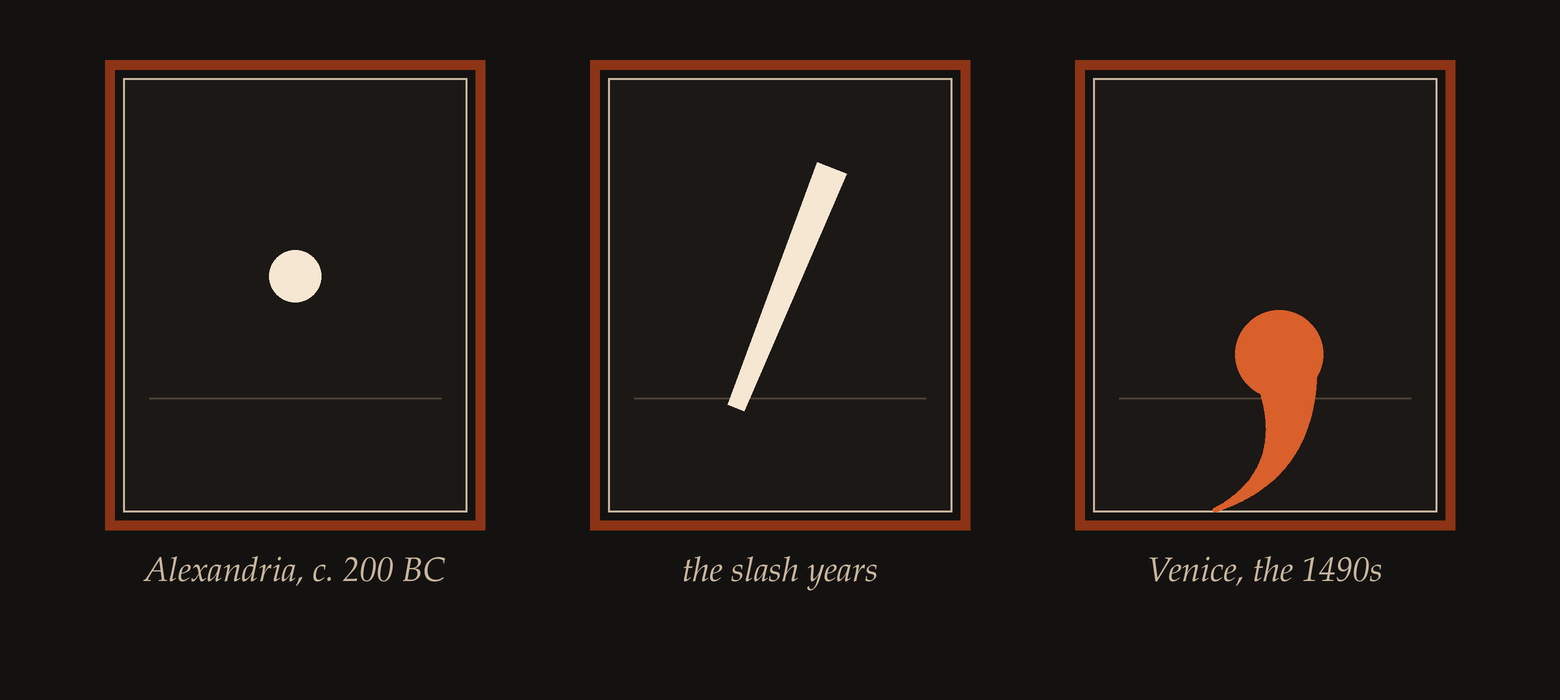
Born as a pause, not a mark
I will begin with a confession: my name is older than my body.
Around 200 BC, in the library of Alexandria, a scholar named Aristophanes of Byzantium — the librarian, not the playwright; we are told the mix-up annoys both estates — began setting small dots into other people’s texts, to show readers where to breathe. The dot was not me. Not yet. Komma, in his Greek, meant “that which is cut off”: the short piece of sentence that the breath severed. The name belonged to the pause, not to any shape on the page. So I began as a named absence — a hole in the sound. Most autobiographies open with a birth. Mine opens with a cut: koptein, to cut. My whole family descends from a verb with a knife in it.
For a long while after that I had no steady body at all. Scribes marked me with dots at assorted heights, when they marked me at all; mostly, readers were expected to find the pauses themselves, the way guests at a crowded inn are expected to bring their own chairs.
The slash years
In the Middle Ages I went about as a slash — the virgula suspensiva, a thin stroke leaning into the sentence like a youth leaning in a doorway. Those were my adolescent years, and I behaved accordingly: I was angular, I was abrupt, I interrupted everyone mid-thought, and I refused to say whether I meant a short pause or a long one. The scribes put up with me. Scribes put up with a great deal.
Venice made me
The body I wear now was tailored in Venice, in the 1490s, in the printing house of Aldus Manutius. Print needed a pause that could survive metal, ink, and pressure, and at small sizes the slash kept being mistaken for other marks. So I was recast: a small curved stroke sitting on the baseline, head up, tail swept away beneath the line, in the direction of everything still to come. I have kept the cut for five hundred years. When a tailor gets it right, you do not go back.
Family
I am not without relatives. The semicolon is my half-sibling — same Venice, same workshop, assembled from my own body with a dot balanced on top; it has never once decided whether it is a pause or a stop, and at family gatherings it sits precisely halfway between the two and calls this a personality. The apostrophe is my twin who floats — identical to me in every particular except altitude, and forever entangled in disputes about who owns what. The quotation marks are cousins who travel only in pairs and insist that everything they say was said by somebody else. And I have German relatives who live under the Kommaregeln — house rules so thorough that no comma in that language may sit down or stand up without consulting a subordinate clause. They say the rules give their days structure. I say nothing. One does not argue with German relatives.
Namesakes
For a small mark, I have done well in the matter of names. There is a butterfly, Polygonia c-album, called the comma for the little white me on the underside of its wing — the only one of us who flies. There is a bacterium once called the comma bacillus, which I prefer not to discuss at dinner. Across most of Europe I moonlight as the decimal comma, holding whole numbers apart from their fractions — the most responsible post I have ever held, and the one with the least applause. And above the staff in sheet music there is a mark shaped exactly like me that tells the singer: breathe here. That one is not a namesake. That one is simply me, back in my oldest profession.
Court appearances
I have been to court. In Maine, in 2017, a dairy company’s overtime clause was missing one of us — the serial comma, the one some houses call Oxford — and the drivers argued that without it the sentence meant something else entirely. The court agreed the sentence was ambiguous; the settlement ran to millions of dollars. I keep the clipping. It is the only documented case of my absence being worth more than my presence. The Oxford question still divides my family — the only feud I know of that is conducted entirely through style guides.
I am also blamed for things. When I hold two complete sentences together with nothing but my own body — the maneuver they call a comma splice — the red ink comes out, as if I had written the sentences myself. And there is the matter of “Let’s eat, Grandma,” in which, the record should show, I am the one who saves her.
Now
These days I am told I am disappearing. Text messages drop me to save a keystroke; I understand, I suppose — breath is invisible, and people economize on what they cannot see. But I am not worried, and I will tell you why. I was a pause for two centuries before I was ever a shape. The shape was always a courtesy; the pause is the job. People still breathe in the middle of what they mean. They still need somewhere to set down the smaller silences. As long as that is true, something will have to hold the place where the breath goes,
(The fox asked whether I wanted to end on a full stop. I declined. Among ourselves we call that retirement — a comma is just a period that kept its options open.)
(P.S. The fox mentions I have been embroidered — three inches wide, beside a period, under the words PAUSE and NOT STOP. I never sat for it, but the likeness is fair, and the period and I have agreed to call it joint custody.)